THE LOST WEEKEND

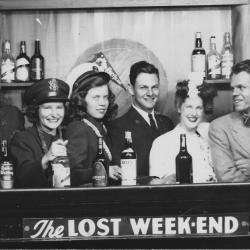
The Bernard Olcott Story starts off 2016 with a rewrite of my post “THE LOST WEEKEND” (the original of which I have just removed from this site).  When I wrote “THE LOST WEEKEND” last June, I reminisced about a picture of my Dad hamming it up with several friends in a photo booth heavy laden with cultural significance – see above picture.  All of which was lost to me since I did not grow up in the 1940s.  I shrugged off that photo booth picture, effectively asking if anyone recognized anything about it.  Nobody did.

That photo, it turns out, is a window into the New York City of yesteryear. This essay, and the next three will use the above image as a departure point into a black and white world.  I’ll take you back to New York City of the 1940s, my Father’s formative years as a newly minted Cooper Union graduate, and you’ll:

  • Read about the biggest movie of 1945,
  • Ride the El,
  • Hear old style New Yorkers interact,
  • Learn a valuable lesson at Cooper Union (a venerable institution dating back to the Lincoln Administration),
  • Review a mysterious death in 1943 with what little facts are available, and
  • Come back to a colorfilled present with a shared activity across time.

Why should you care?  Well, somehow you found this blog.  Perhaps in riding the El with my Dad, you may see some of yours in him.  Maybe you like nostalgic stories about Gotham City which was, in some ways, a completely different city from today’s Big Apple.

It could be that you are intrigued with the backstory of the founding of a business or how the tremendous loss of a parent could leave so little trace behind.  I still haven’t been able to figure out what happened to my paternal Grandmother, who passed away during this era.

Welcome back!
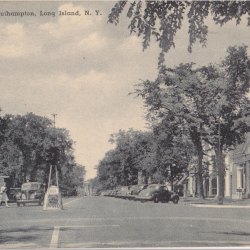
FINDING SOUTHAMPTON

After a busy week in the office of Bernard Olcott & Associates on the 33rd floor of the Pan Am building, it was time to close up shop on Friday afternoon. It was July 1966, the pavement outside was soft from the searing heat of the sun. Summertime transforms Manhattan into a tropical sweaty island, albeit with world-class dining and entertainment options.

We strolled back to Dad’s large efficiency apartment at the Peter Cooper Hotel on 38th and Lexington, grabbed our stuff for the weekend, and took the 7 train out to Long Island City where Dad kept his car, the “horsemobile” – see image below – during the week. Like a Canada Goose in periodic migration, every weekend we plied our way east away from the hot shimmering city onto the Southern State Parkway until it emptied out on country roads. (This was before the Long Island Expressway was extended to Riverhead.) There, we followed Hot Water Road from Manorville all the way down to Route 27, making a left in Eastport. Through picturesque villages with quaint cottage-like storefronts, we wound our way past Katrina’s Deli (the logo was a haunting blond girl wearing a Viking-styled horned helmet), Go Kart tracks, and roadside ice cream parlors with high peaked roofs.

A NIGHT ON THE TOWN IN 1949

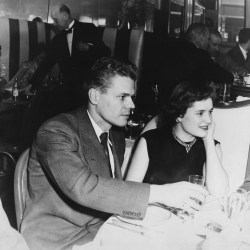
On November 17, 1949, Bernard Olcott and his dashing first wife Patricia Terry of Larchmont, New York spend the evening out on the town. It looks like the wide striped banquet seating of El Morocco but Pat tells me that no, they only hung at The Stork Club or 21.  In any event, this is one of my favorite pictures of Dad, earnest, engaged, and involved.  And looking sharp!

Pat was the first of 5 wives and 5 divorces.  The next wife was an import, a young lady from Quebec City, Canada, my mother Michele.  Number three was another import, this time Graciela from Guayaquil, Ecuador, mother of my sister Victoria.  Like Pat’s, that was another short-lived marriage, lasting about 3 years.  Dad returned to domestic varieties for the last two.  Gloria from Bay Ridge and Stony Brook, Long Island, mother of my sister Blair.  And ending with Rosemary from Washington Heights, NYC (and raised in Metuchen, New Jersey).  Dad was a romantic, to be sure, but he was worse than clueless after marriage.  In fact, there is a strong argument to be made that he was just plain misogynist.  For example, he never ever spoke about his own mother, a mysterious lady named “Patricia Regas.”  I use quotes because she was a Lithuanian immigrant (like his Dad) and I have no idea about what her real name was or anything.  At all.  But more on that later.