MY DAD’S BUDDHIST WEDDING!!

In 1983, Rosemary Egan was a nimble 32 year old brunette who worked the rigging (or the galley) as a crewmember of a 282 foot Windjammer sailing vessel that plied the aqua waters of the Bahamian outer banks.  This was not just any sailing vessel, but a real barkantine, a three-masted ship, square-rigged on the foremast and fore-and-aft-rigged on the other masts.  Up to 30 guests paid for the privilege of waking up in cabins to the sound of sea birds, feasting on lobster, hammocking in the rigging, cannonballing into the ocean and participating in the sailing.

When not hoisting a jib, Rosemary could be found singing and dancing in off-off-Broadway productions.  Show tunes were a specialty of hers.  And if not sailing, singing, or dancing, she had a steady part-time gig as a Medical Assistant.  It’s good to have multiple options.

You could say that she fit a certain profile.

One day after completing a cruise, she was waiting in line to check her luggage at Nassau International Airport for a return flight to Newark, New Jersey.  Born in New York City, she had moved with her folks to Plainview, New Jersey as a youngster during the exodus out of the city proper in the 1960s and 1970s.  Please see my posts “THE END OF AN ERA” and “WELCOME TO NEW JERSEY.”

As she struggled to move her luggage towards the check-in, a handsome stranger who resembled Jack Lord of Hawaii 5-O stepped in to help.  He was awfully chatty and his eyes lit up when he learned that she was part of the crew for Windjammer cruises.  He lifted her bag onto the check-in scale with utmost care and she watched her bag carted away into oblivion as it was promptly lost by the airline for days.  It was an omen of things to come.
HEARTBREAKER

July and August 1992 were interesting times at Olcott International.  I was busy coordinating marketing activities with fellow employee Peggy.  My sister Blair also joined the company for a couple of weeks as she was out of college for the summer; I welcomed her company in yet another attempt to curtail or document Dad’s occasional onslaughts of wild behavior.

Like the time in July 1989 out of the blue one morning he assigned at the last minute a “chore” for me: move 25+ heavy (40 pounds each) 3 x 3 stacks of heavy tiles around the family summer house in Shinnecock Hills, Long Island.  It was beyond my ability.  But no matter.  Later that afternoon, he hunted me down at a friend’s house by telephone to tell me I was disinherited.

Dad was like that.  Apparently, it ran in the family.  Remember my Uncle Ed who out of the blue would also assign overbearing tasks to my cousin Billy and berate him if left uncompleted?

But back to Peggy.  She was a good soul who had a lot of previous experience with legal software and easily did her share of (in this case appropriate) heavy lifting in terms of marketing and support.  At the time, Olcott International sold various versions of patent management software, including ones for DOS, Windows, and Mac!  I learned, and trained clients in, all of them.

The Mac version was a real curiosity.  No one else had it!  Apple’s patent department in Cupertino was definitely intrigued; apparently, they were managing their patent data on a Windows platform, much to their and Steve Jobs’ chagrin.

But in the middle of this patent management business drama appeared a man much like Huntington Hartford or Bobby Edwards.  Out of the blue and completely unexpected.

But in this case, Dr. Wilson Greatbatch was the real deal.  An inventor’s inventor.  The man who had created the pacemaker and who was now going to cure AIDS.  What was he doing in the Weehawken, New Jersey offices of Olcott International?

FROM HAWAI’I WITH LOVE

Notifying a distant family member of the passing of one of their own in the Aloha State is one of the least favorite tasks of the Office of the Chief Medical Examiner of Honolulu County, Hawai’i.  It’s typically done by telephone; calls are made in the morning local time to account for the time difference back on the mainland.

The script is very simple and to the point.  “This is Betty from the Medical Examiner’s Office in Honolulu, Hawai’i.  Mr. Olcott, I’m very sorry to inform you that your brother has died here in Hawai’i.”

In Edward Olcott’s passing, an additional explanation was necessary.  “Your brother passed away last week.  I apologize for the delay in notifying you but we were unable to identify your brother because he expired on the street and was found without any identification.  We surmise that his wallet was stolen when he died.  We had to send his fingerprints to the FBI and we just got the results back this morning.”

Next are the questions about medical history.  “Did your brother suffer from heart disease?  Did he use drugs?”  These are used to confirm the autopsy results.  In Ed’s case, it was a heart attack.

Finally, the key question.  “How will you be taking care of funeral arrangements?”
Now that involves potential cost to the family member answering the phone.  Bernard Olcott never liked to be left with the bill.  He liked it least of all when stuck with the check from the person he had fought so much over so little.  His own brother.

DEATH IN HONOLULU

There is a good reason why the Bernard Olcott Story, every so once in a while, makes a reference to the Aloha State.

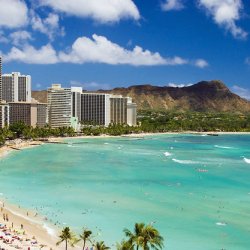
On a late July 1977 morning, a slight man woke up in his modest efficiency apartment near Waikiki, the tourist district of Honolulu.  He was 61 years old, somewhat gaunt, barely five foot seven.  Wrinkles of a hard life lined his face as he switched on the radio after leaving his bed.  The weather forecast came on, as if it were the news.  For Honolulu it isn’t, since the weather is always the same, day in, day out.  Highs will be in the low 80s, lows in the middle 70s.  Winds are “trade.”  Winds are always trade in Hawai’i (unless a cyclone comes to visit, of course.)

The weathered man had lived some thirty years previous at 3169 Alika Avenue in the Nu’uana – Punchbowl neighborhood, an up country residential district.  The previous week, he had decided to travel from his current home in Exeter, New Hampshire to come back here to retrace his steps as a young naval officer and maybe plumb his soul.  It’s about the longest trip you can make in the USA and still remain in the land of the free.

He found himself later that morning on Ala Moana Boulevard wandering alone in the sunshine on Wednesday, the 26th of July in 1977.  As Honolulu is the southern-most metropolis in the nation, at these latitudes, the sun can cause a bad sunburn in as little as 15 minutes.  The fair skin of a new arrival from Northern New England is at particular risk.

The man stopped in his tracks, his pace suddenly unsteady.  As he wiped the sweat off his forehead, the traffic swirled around him and he became disoriented.  It wasn’t the bright sun that had gotten to him, but a sharp pain in his upper chest.  He gripped himself, but could only stagger forward and reach out vainly with his free arm.  When he dropped to the pavement, he cut his face on the sidewalk.  His last sight on this planet was the passing traffic – buses, trucks, cars – from ant level.

As the dying man went down, passersby unknown took advantage of his incapacity, rapidly relieving him of his wallet, cash, and watch.  By the time help arrived, the corpse on the sidewalk could no longer identify himself.

The Honolulu County Medical Examiner later that day fingerprinted “John Doe.”  A match came back the next day – from military records.

The man’s name was

THE FINEST ESCAPE!

The Bernard Olcott Story started off 2016 with a rewrite of my post “THE LOST WEEKEND” focusing on the Academy Award (and Cannes!) winning movie of the same name from 1946.  That post promised the following stories to come:

• the biggest movie of 1946 (THE LOST WEEKEND),
• the 3rd Avenue El (including an art house film),
• old style New Yorkers interacting in flavorful accents,
• a valuable lesson at Cooper Union
• a mysterious death in 1943 with what little facts are available, and
• a color-filled present with a shared activity across time.

All have been delivered, except for the last topic.  I did leave the 1940s to take you, the dear reader, on a color-filled ride 40 years later to Lithuania in 1985.  I framed my trip in terms of a Boomerang where I realized that my journey, as an effort to strengthen family ties, may have inadvertently reminded my Dad of his disadvantaged youth.  Both in terms of society – his immigrant household subject to prejudice – and family – where his brother was favored in the household.

But wait!  There’s more to that technicolor present!  Today’s post will wrap up both the Boomerang and 1940s themes with the following conclusion: my Dad escaped his unhappy situation 4 ways:

1. Becoming a sailor on the Merchant Marines and shipping off to Europe
2. Flying the coop to Cooper Union
3. Becoming a Technology Consultant
4. By engaging in a mystery activity (identified below), one that he and I both share.

BOOMERANG RETURNS!

Today the Bernard Olcott story returns to Vilnius, May 1985.  From my post “BOOMERANG THROWN,” you learned that I was in Lithuania for 5 days that year, hunting down my family roots.  The first day was remarkable.

My second day in Lithuania featured an old fashioned get-on-the-bus touristic outing with my Intourist group.  The destination was the town and castle at Trakai, about 30 km to the west of Vilnius.  Built in the 15th century as the home to the Lithuanian Grand Duke, it was considered as the unofficial capital of Lithuania, which, as part of the united Polish-Lithuanian kingdom, stretched from the Baltic to the Black Seas in its prime.  Today the ancient castle is in good condition – for a structure that is 600+ years old – and is scenically located on an island in a pristine clear water lake.

BOOMERANG IN THE AIR FROZEN


This blog ostensibly concerns my Father, Bernard, who passed away in 2006.  But I take many diversions along the way.  Today’s post is mostly about his 2nd wife, my Mom.  She is a spry 83 year old woman who brags about her ability to walk around the parking lot in front of her Assisted Living Residence “23 times” every day.  She is very specific about that number.

OK, so what do you do with your aging Mother when you bring her home for the weekend?  In my case, I take her for long walks.  Makes sense, right?

This past Sunday, I brought her and my cousin, Lise (visiting from Quebec City), for an excursion to the Four Freedoms Park on Roosevelt Island.  It’s a stunning modern memorial to, in my opinion, the greatest President of our Republic.  Our very own Great Leader, the handicapped patrician who led our country through its darkest hour to supreme victory and ascendancy to superpower status, militarily, economically, and culturally.  FDR.  Now we have a Washington, DC-style monument in his honor, right here in the middle of the East River.

THE FACES OF THE CROSS

Traveling throughout Lithuania, one cannot help but notice the graceful tendrils that inhabit many rural intersections, hilltops, byways, and of course church tops.  Whereas in my country, we had a mysterious person named Johnny Appleseed who planted apple trees everywhere, in Lithuania, teams of anonymous craftsmen traveled far and wide to plant ornamental crosses everywhere (like the one above).

You cannot help but notice them here and there, like ghostly roadside shrines in Mexico.  Every cross, called kryžius in Lithuanian, is different, just like a snowflake.

Adorned with these threadlike appendages, they seem to vibrate in the air or undulate under water like sea anemones. Like the statues that inhabit the fairy palace in George MacDonald’s Phantastes, you have the impression of faint movement when your back is turned.  But when you fix your gaze on them, they suddenly stiffen and still themselves.  They are as numerous as mushrooms on a damp forest floor.  So many, that they become ubiquitous in the landscape and render the Lithuanian paysage as a sort of fairyland.

SOVIET MINDERS AND TOILETS

It had been an eventful drive from Vilnius to Varena that sun-drenched spring morning in May 1985.

First was being pulled over by the USSR highway patrol.  It looks fearsome just to see it here in writing on the Bernard Olcott story.  But Boris the driver managed not to collect S&H green stamps from the patrolboy.

Second was a stop at a World War II massacre site to learn a lesson about oppression.  A moment of irony in the USSR.

Next up was our ostensible destination, the town of Varena, Dzūkija region, in Southeastern Lithuania.   My Dad’s cousin Eugenija lived there with her husband in the old part of town.  Their broom-swept house turned out to be at the top of a T intersection, a few feet away from an ominous looking empty small guard tower.  Asleep in the tall grass at the base was a disheveled drunk, who was quickly roused and sent away.

IN SEARCH OF… MY FATHER’S MOTHER!

Before I cover the apparently sudden demise of my father’s mother Patricia in Queens, NY, on August 22, 1943, let me backtrack a bit and take a look at her origins.  At least the little that is known.  So I go in search of…  my paternal grandparents!

For that, my story today starts off on one beautiful bright Saturday morning in May 1985.  I was in a rental car rolling through verdant countryside.  The birds were chirping, the sun was streaming, and my Al Green cassette tape was cranking through the sound system; Al crooning “Love and Happiness.”  It was a happenin’ morning!

Yet this was not your normal stretch of New Jersey Turnpike, say between Elizabeth and Rahway.  Nor was I in a 1984 Buick LeSabre.  This road trip was distinctive for many reasons!

Well for one thing, the player’s fast forward was broken so when I got to the end of the last song on side 1, I had to eject the tape, stick my finger into one sprocket, and twirl the tape around my finger until I got to the end of side 1 (which was the beginning of side 2).

But that was just a nit.  Maybe it had something to do with the fact that I was rockin’ a recent vintage Volga sedan like the one pictured below.

MHV_ZiL_117_01

Switch out I-95, and sub-in the fact that I was rolling southbound on the A4, a rural two lane highway in Soviet occupied Lithuania.