ODD THINGS ABOUT TRIPS

All pictures of holes in hand, Bobby drove us back to Kansas City International Airport for our flight back to Newark.  I remember looking out the window on our descent, seeing only white.  Suddenly, below me, the New Jersey Turnpike appeared in patches out of the murk, looking cloudy, grayish, and flakey.  It was snowing, and it looked like it had been at it for a while.  We were so low over the white roadway, I thought we were going to land on it.

From brown Kansas to white New Jersey.  To be sure it had been a kind of odd-ball trip.  Going to Kansas to take pictures of holes.  More typically, my business trips back then took me to London, which was a very different kind of experience.  For one thing, England (the tourist web site has a page for “things to do on a rainy day.”) is a very “wet” country, and I developed a liking for pints hand drawn from the draught.  No need to buy a membership – everyone was a member!

This post is about England.

THE HOLEY LAND, PART 1

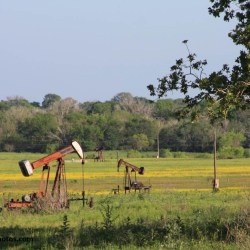
Above photo of Kansas highway courtesy of Erik Trautman

The following Monday morning, I got up a little earlier than usual in my apartment in Yorkville, Manhattan.  I put on a pair of jeans and my Timberland boots as this here urban cowboy was going to work on the oil field for the week.  Well ok, maybe not exactly.  I was really going to be a tag-along on the oil patch.  To be on the heels of the world-famous Jewish cowboy and oil rustler, Bobby Edwards!

I grabbed a cab and directed the driver to Bobby’s place on East 86th Street.  As we pulled up to the awning on Bobby’s building, he was, of course, nowhere to be seen.  We waited as the doorman called up.  “Mr. Edwards will be right down.”  I wondered if everyone’s workweek on the oil patch started this way.

After a few moments, Bobby arrived at the car, huffing and puffing with his suitcase.  “LaGuardia Airport for TWA Airlines, please,” he barked to the driver in his raspy voice as he staggered into the cab.  We were on our way to an 8AM flight to Kansas City International Airport.  “Wait ‘til you see Kansas, kid,” he laughed and coughed.  “Looks just like 86th Street.”

Doesn’t everywhere?

Once at the Central Terminal (which, at LaGuardia, is Terminal B, not C: go figure), I followed Bobby to the check-in counter at our gate.  He slouched up against it and whipped out a money clip.  On one side were several Gold and Platinum ‘Elite’ TWA Frequent Flyer cards.  On the other side were several Benjis ($100 bills).  Bobby winked at me as he addressed the check-in agent while clicking the clip on the desk.  “Hi Linda, how are you this morning,” he said as if he had played doctor with Linda in kindergarten.
benji

“Fine, Mr. Edwards.  How are you?” she said pleasantly if nonchalantly as the printer spat out two boarding passes.  After handing him our seat assignments, we soon took our coach places towards the rear of the empty aircraft.

CHIGGERS AND STRIPPERS

Above: Stripper wells, courtesy of http://www.energyindustryphotos.com/texas_oil_well_photos.htm

East 86th Street figures prominently in The Bernard Olcott Story.  First, my Dad lived on the corner of Fifth Avenue with his second wife and baby, James.  Several years later, he moved further east to Second where he lived with his third wife and baby, Victoria.  (The aforementioned son lived with this growing and eclectic family during summers).

Had you kept going further east, you would arrive at the residence of one Robert Edwards, otherwise known as “Bobby.”  Whereas other residents of Yorkville typically wore suits during the workday, Bobby always looked like he was going to a rodeo.

As introduced in last week’s story, “MR. SWAGGER’S PUMP AND DUMP,” Bobby was probably the most colorful character ever to have enjoyed the select distinction of “Business Partner of Bernard Olcott.”

By the early 1980s, Dad already had experience in investing in oil and gas exploration.  It was one of the best tax shelters in that the entire investment could be written off as an “intangible drilling” deduction.  Then, later on, after you would have drilled for oil, found some (there are no guarantees), extracted it via a pump jack into a tank, and finally have Enron come buy it from you, you could claim it as income at reduced capital gains rate.

Potential problems?  Of course there is always the possibility of a fly in the ointment.

HEARTBREAKER

July and August 1992 were interesting times at Olcott International.  I was busy coordinating marketing activities with fellow employee Peggy.  My sister Blair also joined the company for a couple of weeks as she was out of college for the summer; I welcomed her company in yet another attempt to curtail or document Dad’s occasional onslaughts of wild behavior.

Like the time in July 1989 out of the blue one morning he assigned at the last minute a “chore” for me: move 25+ heavy (40 pounds each) 3 x 3 stacks of heavy tiles around the family summer house in Shinnecock Hills, Long Island.  It was beyond my ability.  But no matter.  Later that afternoon, he hunted me down at a friend’s house by telephone to tell me I was disinherited.

Dad was like that.  Apparently, it ran in the family.  Remember my Uncle Ed who out of the blue would also assign overbearing tasks to my cousin Billy and berate him if left uncompleted?

But back to Peggy.  She was a good soul who had a lot of previous experience with legal software and easily did her share of (in this case appropriate) heavy lifting in terms of marketing and support.  At the time, Olcott International sold various versions of patent management software, including ones for DOS, Windows, and Mac!  I learned, and trained clients in, all of them.

The Mac version was a real curiosity.  No one else had it!  Apple’s patent department in Cupertino was definitely intrigued; apparently, they were managing their patent data on a Windows platform, much to their and Steve Jobs’ chagrin.

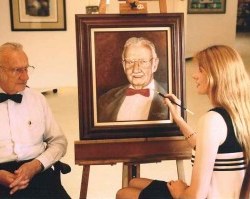
But in the middle of this patent management business drama appeared a man much like Huntington Hartford or Bobby Edwards.  Out of the blue and completely unexpected.

But in this case, Dr. Wilson Greatbatch was the real deal.  An inventor’s inventor.  The man who had created the pacemaker and who was now going to cure AIDS.  What was he doing in the Weehawken, New Jersey offices of Olcott International?

THE BIGGER IDEA (AS TED’S WINGMAN)

As recounted in my last post ‘THE INTERSECTION,” Dad went back to the patent drawing board in 1998 (at the young age of 80).  He was intrigued by various developments in the America’s Cup race, and as a new member of the New York Yacht Club, he set out to prove his bona fides both as a sailor and as an inventor.  Accompanied by his usual gusto for going with what he knew.  Natch.

By 1998, there had already been four America’s Cup races since the New York Yacht Club lost it in 1983.  A new challenge was pending in 2000 and Dad wanted in.

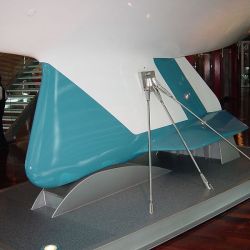
The race in 1983 had been won by the yacht Australia II due to its specialized keel design.  In fact, when the boat was first brought over from down under, the keel was physically shrouded so that no one could see it!

What was the big secret?

THE INTERSECTION

On West 44th Street in midtown Manhattan, a few doors down from the Harvard Club, stands a stately landmark building.  Designed by the architectural firm of Warren and Wetmore – the same team that did Grand Central Station – the façade features both Beaux-Arts and nautical styles.  Three magnificent windows to the left of the entrance are crafted to resemble the sterns of 18th century galleons.

Lights pour in through those windows to illuminate one of the most curious chambers in the metropolis.  It’s a grand room where more than 150 years of sailing history is preserved.  Specifically, the main exhibit documents the competition for the America’s Cup sailing race from the first event in 1851 up to the present.  In each regatta, a replica of the American boat, known as the defender, (from the New York Yacht Club up until 1983) is presented alongside the main competitor, the challenger, always English (at least at the beginning).  The determining factor for the victor is not indicated but is usually visible.

As long as you know where to look.  Dad did.