THE INTERSECTION

On West 44th Street in midtown Manhattan, a few doors down from the Harvard Club, stands a stately landmark building.  Designed by the architectural firm of Warren and Wetmore – the same team that did Grand Central Station – the façade features both Beaux-Arts and nautical styles.  Three magnificent windows to the left of the entrance are crafted to resemble the sterns of 18th century galleons.

Lights pour in through those windows to illuminate one of the most curious chambers in the metropolis.  It’s a grand room where more than 150 years of sailing history is preserved.  Specifically, the main exhibit documents the competition for the America’s Cup sailing race from the first event in 1851 up to the present.  In each regatta, a replica of the American boat, known as the defender, (from the New York Yacht Club up until 1983) is presented alongside the main competitor, the challenger, always English (at least at the beginning).  The determining factor for the victor is not indicated but is usually visible.

As long as you know where to look.  Dad did.

MY DAD INVENTED THE INTERNET

Well, not exactly.  But he did, in the 1950s, come up with the idea under which a majority of equity and debt trades today are effected in current financial markets.  Not that the markets followed his proposal at the time.  Far from it.  But with this idea, my Dad did actually see around the corner.  Let me explain.

Dad was essentially an inventor at heart.  This is what engineers do, conceive of new things. As People’s Exhibit No. 1, consider the following work:

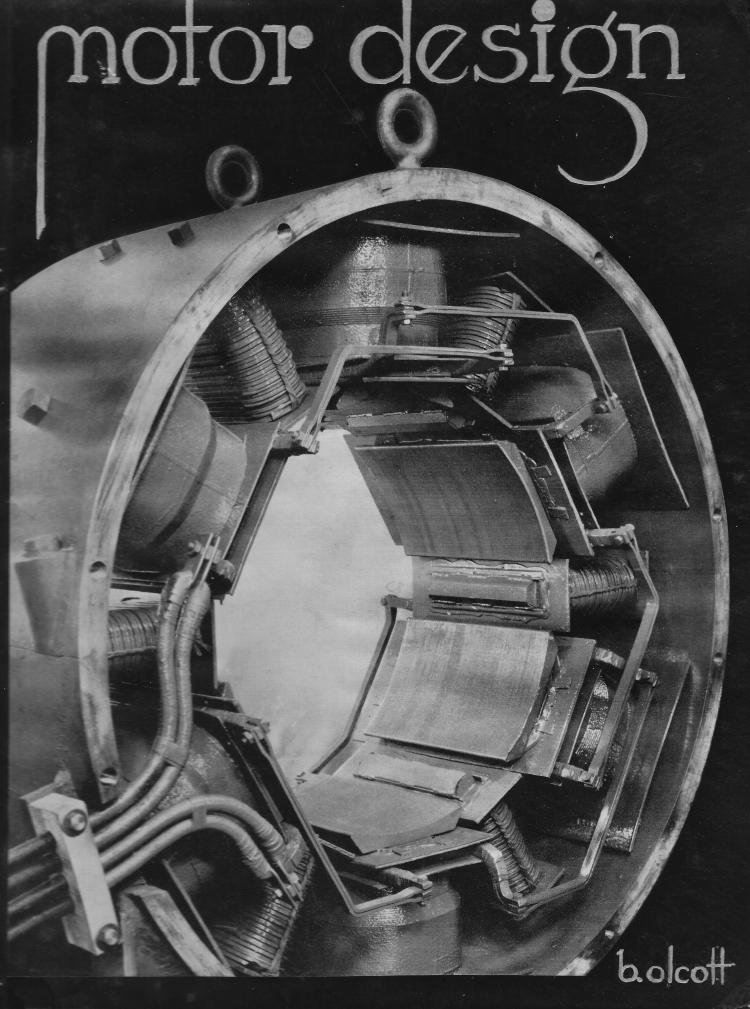
Motor Design Cover

This is the cover of a treatise entitled “Motor Design.” It was his final project for his first year at Cooper Union.  Dated May 18, 1938, it concerns engines for boats.  Of course boats!  What else would a waterman write about?

LAST CALL FOR EDWARD

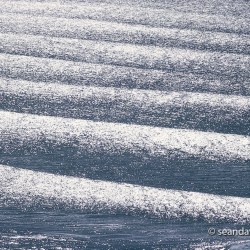
Sun.  Sea Spray.  Hull smashing through rows of swells.  The ship’s deck heaving from and dropping into an endless parade of oncoming waves.  Turn your face towards the sun and catch a million dancing reflections on the water glistening back at you.

If you’re on a sailboat, there is no engine noise, just the sound of wind blowing through your hair.

Both Olcott brothers were watermen, even though they were descendants of the landlocked Dzūkija region of Lithuania.  I am a waterman too, raised on many afternoons of sailing on Shinnecock Bay, Long Island during my young summers in the 1960s with my Dad.

However, by the age of twelve, I had discovered a simple way to elevate the pleasure and excitement of wind, sea, and waves.  Instead of being on a boat in the water, how about doing away with the boat?  Watch sets of giant waves roll in while at sea level, exactly.  Body surfing.  Maximum exposure.  If you could time and catch them right, you could slide down a crystal slope while the tube of water breaks above and behind you.  The payoff is maybe eight seconds of pure exhilaration that seems to last perhaps up to half an hour.  You’ll never forget the view of giant slopes of water marching towards you, with the last wave looming higher over the others.  That last one, with the face of the sun sparkling back at you, will be the wave you want.  And sometimes, it will take a fair amount of courage to try to pick off that last wave, the king of the set.

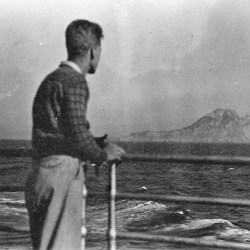
But this was me in the water, maybe 30-50 yards away from the shore.  Both my Dad and his Brother crossed the oceans – what about seeing rogue waves 3,000 miles offshore?  I shudder to think what they must have gone through.

THE FINEST ESCAPE!

The Bernard Olcott Story started off 2016 with a rewrite of my post “THE LOST WEEKEND” focusing on the Academy Award (and Cannes!) winning movie of the same name from 1946.  That post promised the following stories to come:

• the biggest movie of 1946 (THE LOST WEEKEND),
• the 3rd Avenue El (including an art house film),
• old style New Yorkers interacting in flavorful accents,
• a valuable lesson at Cooper Union
• a mysterious death in 1943 with what little facts are available, and
• a color-filled present with a shared activity across time.

All have been delivered, except for the last topic.  I did leave the 1940s to take you, the dear reader, on a color-filled ride 40 years later to Lithuania in 1985.  I framed my trip in terms of a Boomerang where I realized that my journey, as an effort to strengthen family ties, may have inadvertently reminded my Dad of his disadvantaged youth.  Both in terms of society – his immigrant household subject to prejudice – and family – where his brother was favored in the household.

But wait!  There’s more to that technicolor present!  Today’s post will wrap up both the Boomerang and 1940s themes with the following conclusion: my Dad escaped his unhappy situation 4 ways:

1. Becoming a sailor on the Merchant Marines and shipping off to Europe
2. Flying the coop to Cooper Union
3. Becoming a Technology Consultant
4. By engaging in a mystery activity (identified below), one that he and I both share.

BOOMERANG RETURNS!

Today the Bernard Olcott story returns to Vilnius, May 1985.  From my post “BOOMERANG THROWN,” you learned that I was in Lithuania for 5 days that year, hunting down my family roots.  The first day was remarkable.

My second day in Lithuania featured an old fashioned get-on-the-bus touristic outing with my Intourist group.  The destination was the town and castle at Trakai, about 30 km to the west of Vilnius.  Built in the 15th century as the home to the Lithuanian Grand Duke, it was considered as the unofficial capital of Lithuania, which, as part of the united Polish-Lithuanian kingdom, stretched from the Baltic to the Black Seas in its prime.  Today the ancient castle is in good condition – for a structure that is 600+ years old – and is scenically located on an island in a pristine clear water lake.

BOOMERANG IN THE AIR FROZEN


This blog ostensibly concerns my Father, Bernard, who passed away in 2006.  But I take many diversions along the way.  Today’s post is mostly about his 2nd wife, my Mom.  She is a spry 83 year old woman who brags about her ability to walk around the parking lot in front of her Assisted Living Residence “23 times” every day.  She is very specific about that number.

OK, so what do you do with your aging Mother when you bring her home for the weekend?  In my case, I take her for long walks.  Makes sense, right?

This past Sunday, I brought her and my cousin, Lise (visiting from Quebec City), for an excursion to the Four Freedoms Park on Roosevelt Island.  It’s a stunning modern memorial to, in my opinion, the greatest President of our Republic.  Our very own Great Leader, the handicapped patrician who led our country through its darkest hour to supreme victory and ascendancy to superpower status, militarily, economically, and culturally.  FDR.  Now we have a Washington, DC-style monument in his honor, right here in the middle of the East River.

BOOMERANG THROWN

The past 5 posts describe the first of the 5 days staying at the Hotel Lithuania (not to be confused with the Hotel California).  In Vilnius, Soviet occupied Lithuania during May 1985.  Intermingled in the details were other anecdotes about my stay in Moscow the prior week.

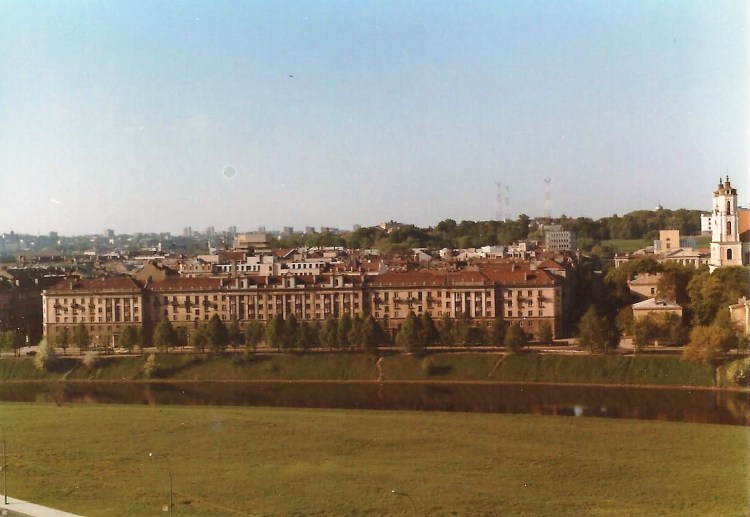
View from my window at the Lietuva

My view out the window of the Hotel Lietuva.  The Neris River is in the foreground and the Old Town behind.

For the sake of repetition, my primary purpose in going to Lithuania was to meet my Father’s family, his uncle and cousins.  Our roots in this small, little-known country in Eastern Europe was something we shared.  Plain and simple.

Curly Hair

The author with Eugenija’s son (and my cousin) Vytas.  At least I figured out where my curly hair came from!

When I got there, I discovered insights into what exactly constitutes oppression.  Some of it boomeranged to hit me in strange ways.

THE FACES OF THE CROSS

Traveling throughout Lithuania, one cannot help but notice the graceful tendrils that inhabit many rural intersections, hilltops, byways, and of course church tops.  Whereas in my country, we had a mysterious person named Johnny Appleseed who planted apple trees everywhere, in Lithuania, teams of anonymous craftsmen traveled far and wide to plant ornamental crosses everywhere (like the one above).

You cannot help but notice them here and there, like ghostly roadside shrines in Mexico.  Every cross, called kryžius in Lithuanian, is different, just like a snowflake.

Adorned with these threadlike appendages, they seem to vibrate in the air or undulate under water like sea anemones. Like the statues that inhabit the fairy palace in George MacDonald’s Phantastes, you have the impression of faint movement when your back is turned.  But when you fix your gaze on them, they suddenly stiffen and still themselves.  They are as numerous as mushrooms on a damp forest floor.  So many, that they become ubiquitous in the landscape and render the Lithuanian paysage as a sort of fairyland.

SOVIET MINDERS AND TOILETS

It had been an eventful drive from Vilnius to Varena that sun-drenched spring morning in May 1985.

First was being pulled over by the USSR highway patrol.  It looks fearsome just to see it here in writing on the Bernard Olcott story.  But Boris the driver managed not to collect S&H green stamps from the patrolboy.

Second was a stop at a World War II massacre site to learn a lesson about oppression.  A moment of irony in the USSR.

Next up was our ostensible destination, the town of Varena, Dzūkija region, in Southeastern Lithuania.   My Dad’s cousin Eugenija lived there with her husband in the old part of town.  Their broom-swept house turned out to be at the top of a T intersection, a few feet away from an ominous looking empty small guard tower.  Asleep in the tall grass at the base was a disheveled drunk, who was quickly roused and sent away.

(SOUR) LESSON OF HISTORY

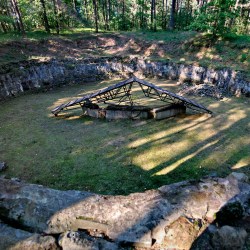
Ponary Death Pit (photo courtesy of Juliux from Wikipedia – Own work, CC BY-SA 3.0)

Courtesy of my driver Boris and his lead foot, fueled by my Al Green cassette tape, our Russian Volga sedan resumed its cruise down the A4 highway towards my lunch appointment with my father’s family in Varena, Lithuania.  We had just survived a traffic stop a few moments earlier where Boris effectively told the zit-faced highway patroller to go fuck himself.  The USSR seemed to have a great surfeit of immature officers populating the police, immigration, customs, animal control, and doubtlessly numerous other constabularies.

My very first experience of the Soviet Union the previous week was instructive of this very point.  It was upon my arrival into the USSR on an Air France nonstop flight from Charles de Gaulle to Sheremetyevo airports.

It was May 1985, and, as a student of history and world politics, I was excited to be flying into a very different kind of country.  I had had some extensive experiences in Europe already, but this, the USSR was to be verily alien.  As a kicker, I would be meeting my Father’s family in Lithuania after a week in Moscow.

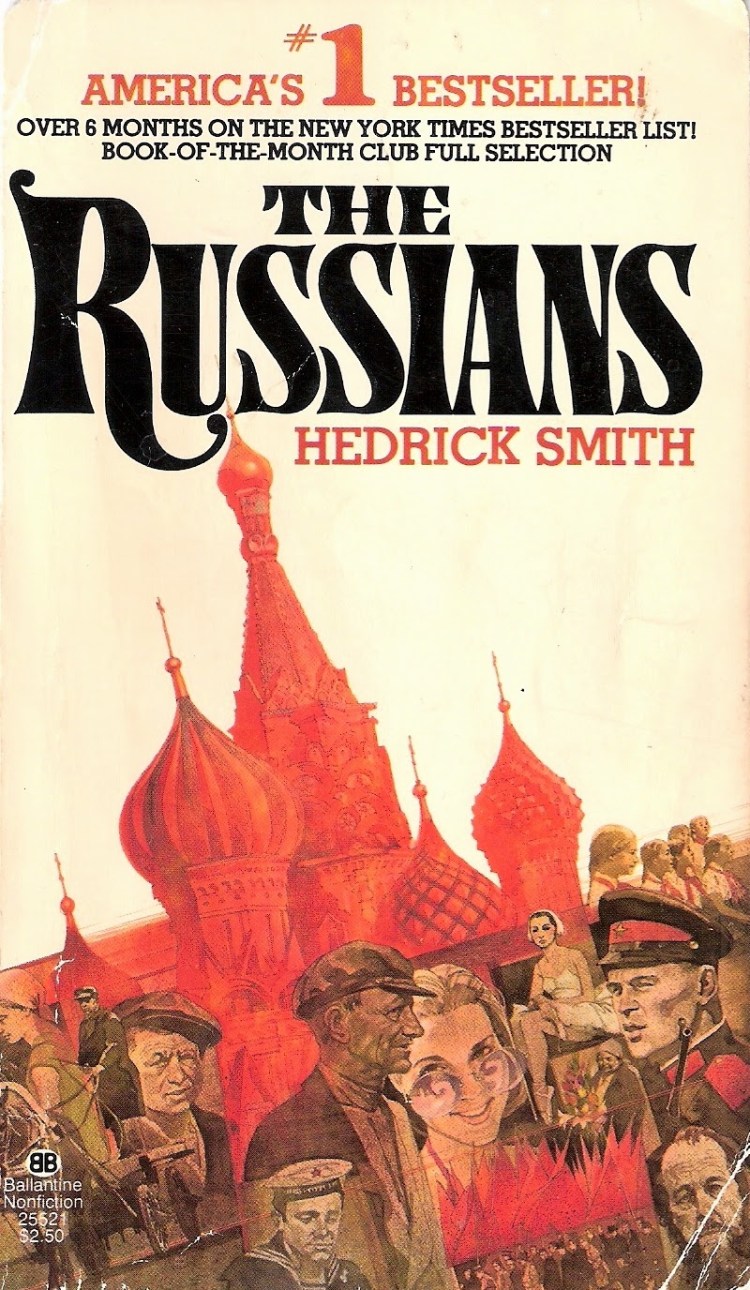
In preparation for my trip, I read everything I could about Russians (inhabitants of the world’s largest country), Lithuanians (great basketball players), and the Baltics (I would also be passing through Riga, Latvia).  Hedrick Smith’s “The Russians” had earned a prized place in my personal library, with dog-ears on the dog-ears.