THE FACES OF THE CROSS

Traveling throughout Lithuania, one cannot help but notice the graceful tendrils that inhabit many rural intersections, hilltops, byways, and of course church tops.  Whereas in my country, we had a mysterious person named Johnny Appleseed who planted apple trees everywhere, in Lithuania, teams of anonymous craftsmen traveled far and wide to plant ornamental crosses everywhere (like the one above).

You cannot help but notice them here and there, like ghostly roadside shrines in Mexico.  Every cross, called kryžius in Lithuanian, is different, just like a snowflake.

Adorned with these threadlike appendages, they seem to vibrate in the air or undulate under water like sea anemones. Like the statues that inhabit the fairy palace in George MacDonald’s Phantastes, you have the impression of faint movement when your back is turned.  But when you fix your gaze on them, they suddenly stiffen and still themselves.  They are as numerous as mushrooms on a damp forest floor.  So many, that they become ubiquitous in the landscape and render the Lithuanian paysage as a sort of fairyland.

SOVIET MINDERS AND TOILETS

It had been an eventful drive from Vilnius to Varena that sun-drenched spring morning in May 1985.

First was being pulled over by the USSR highway patrol.  It looks fearsome just to see it here in writing on the Bernard Olcott story.  But Boris the driver managed not to collect S&H green stamps from the patrolboy.

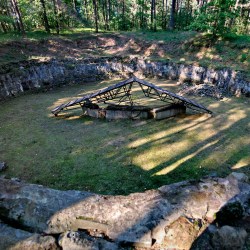
Second was a stop at a World War II massacre site to learn a lesson about oppression.  A moment of irony in the USSR.

Next up was our ostensible destination, the town of Varena, Dzūkija region, in Southeastern Lithuania.   My Dad’s cousin Eugenija lived there with her husband in the old part of town.  Their broom-swept house turned out to be at the top of a T intersection, a few feet away from an ominous looking empty small guard tower.  Asleep in the tall grass at the base was a disheveled drunk, who was quickly roused and sent away.

(SOUR) LESSON OF HISTORY

Ponary Death Pit (photo courtesy of Juliux from Wikipedia – Own work, CC BY-SA 3.0)

Courtesy of my driver Boris and his lead foot, fueled by my Al Green cassette tape, our Russian Volga sedan resumed its cruise down the A4 highway towards my lunch appointment with my father’s family in Varena, Lithuania.  We had just survived a traffic stop a few moments earlier where Boris effectively told the zit-faced highway patroller to go fuck himself.  The USSR seemed to have a great surfeit of immature officers populating the police, immigration, customs, animal control, and doubtlessly numerous other constabularies.

My very first experience of the Soviet Union the previous week was instructive of this very point.  It was upon my arrival into the USSR on an Air France nonstop flight from Charles de Gaulle to Sheremetyevo airports.

It was May 1985, and, as a student of history and world politics, I was excited to be flying into a very different kind of country.  I had had some extensive experiences in Europe already, but this, the USSR was to be verily alien.  As a kicker, I would be meeting my Father’s family in Lithuania after a week in Moscow.

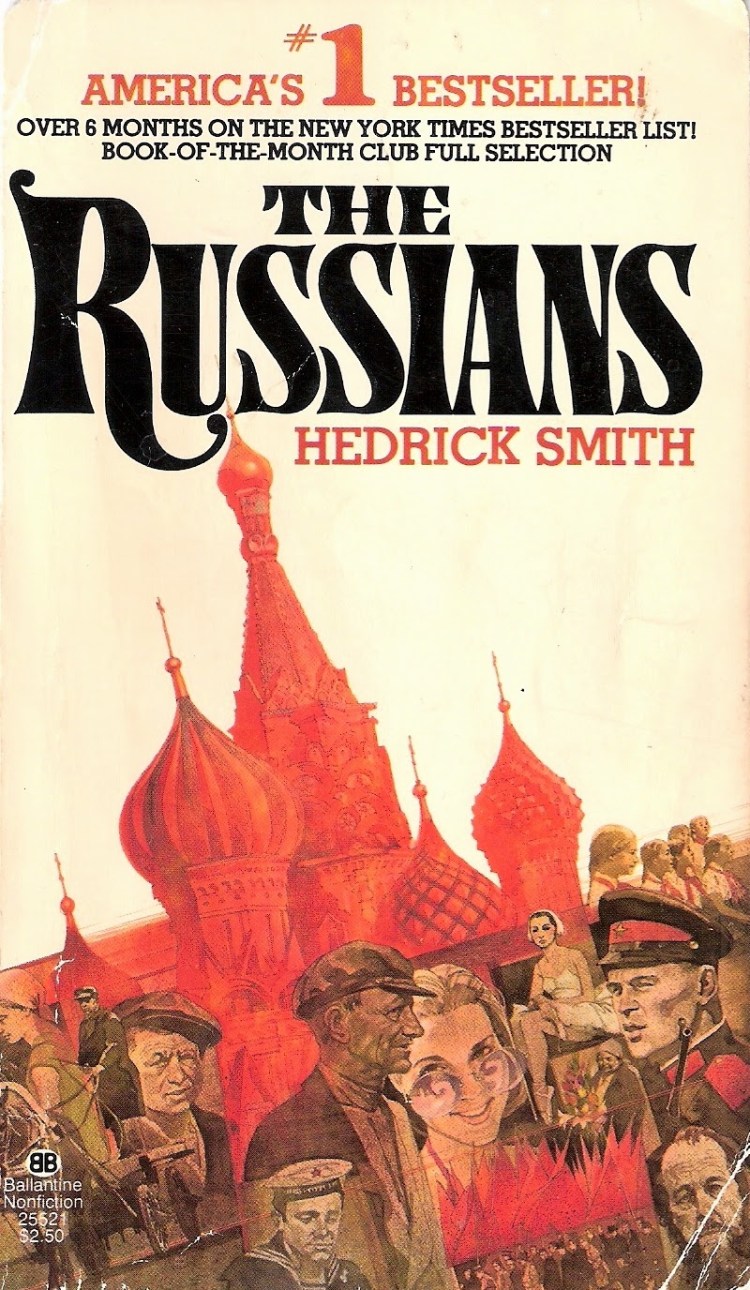
In preparation for my trip, I read everything I could about Russians (inhabitants of the world’s largest country), Lithuanians (great basketball players), and the Baltics (I would also be passing through Riga, Latvia).  Hedrick Smith’s “The Russians” had earned a prized place in my personal library, with dog-ears on the dog-ears.

HANGING PORK

(WARNING: THIS POST CONTAINS CONTENT BORROWED FROM GOP DEBATES.  PLEASE DO NOT READ IF YOU ARE OFFENDED BY GOP DEBATE CONTENT!)

Back home in America, the highway traffic stop is probably the greatest display of power a state like New York, New Jersey, Hawai’i (or any of the 47 others and 1 district) can exert over an unfortunate traveler.  There is an additional risk of nastiness if you happen to be driving while intoxicated, black, or as an American in the backroads of the USSR.  I fell solidly in the last two categories.

Back home, the cop car that pulls you over on I-95 (or H-1) is typically a blazing high performance Ford Crown Victoria festooned with the great seal of the state under whose laws, you, the hapless driver have apparently transgressed.  You get the whole show, complete with stylized hat, jack boots, ribboned trousers, shoulder brushes, leather pistol holster, handcuffs, the works.  Every state has its own variant of this uniform.  Be a very wary bear.

Dancing Bears cropped

Russian bears do dance, but these ain’t Russian!

Wrapped in the aforementioned trappings of authority, US States perform traffic stops with overdone celebratory unctuousness.  But everyone considers Connecticut or Alaska or the District to be relatively toothless.  We know, for example, that Connecticut is not going to build a wall around itself or deport everyone of Rhode Island descent. Not that there aren’t criminals from Providence stealing algae from the Connecticut River.  But I digress.  The states flash a lot of power by way of shiny patrol cars and uniform embellishments (big bark), but rank low on the holocaust scale (little dick).

IN SEARCH OF… MY FATHER’S MOTHER!

Before I cover the apparently sudden demise of my father’s mother Patricia in Queens, NY, on August 22, 1943, let me backtrack a bit and take a look at her origins.  At least the little that is known.  So I go in search of…  my paternal grandparents!

For that, my story today starts off on one beautiful bright Saturday morning in May 1985.  I was in a rental car rolling through verdant countryside.  The birds were chirping, the sun was streaming, and my Al Green cassette tape was cranking through the sound system; Al crooning “Love and Happiness.”  It was a happenin’ morning!

Yet this was not your normal stretch of New Jersey Turnpike, say between Elizabeth and Rahway.  Nor was I in a 1984 Buick LeSabre.  This road trip was distinctive for many reasons!

Well for one thing, the player’s fast forward was broken so when I got to the end of the last song on side 1, I had to eject the tape, stick my finger into one sprocket, and twirl the tape around my finger until I got to the end of side 1 (which was the beginning of side 2).

But that was just a nit.  Maybe it had something to do with the fact that I was rockin’ a recent vintage Volga sedan like the one pictured below.

MHV_ZiL_117_01

Switch out I-95, and sub-in the fact that I was rolling southbound on the A4, a rural two lane highway in Soviet occupied Lithuania.

IN DEMAND, AND THEN NOT

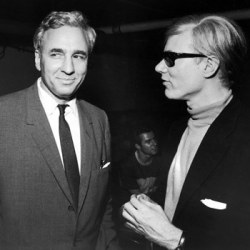
Huntington Hartford and Andy Warhol.  Photo courtesy of Vanity Fair.

A couple of weeks ago, one Sunday evening, I was driving back to my home in New York City from Hunter Mountain in upstate New York.  Most of my drive home was spent on the New York State Thruway, the major vehicular artery connecting the city to the state capital, Albany, and then on to Montréal via a continuation called the Northway.

As I approached the New Jersey border (please see my post WHAT’S IN A BORDER) driving southbound, I passed by Schunemunk Mountain on my right and then a succession of some small hills and valleys.  I also drove under a pedestrian overpass where I used to play a silly game with my children; the object of the game was to cross directly over the path of an oncoming car and get ‘run over’ (except, of course, you are on the overpass above).  Small children love this game – the direct opposite of “don’t play in traffic” – as well as parents with the mind of a small child.

Before crossing the border, I passed through a small dreary rural town called Hillburn.  After crossing, the sprawl of suburbanization was immediately palpable.

The last 20 miles took me through the northwest corner of New Jersey.  One of my favorite stops is a well-stocked A&P Supermarket in Allendale.  Not only does it feature a great selection of grocery items at low prices, but also has an unexpectedly good selection of wines.  Like 10 year old Pauillacs, perfect for drinking, which cannot be found in Manhattan (at least not 10 year old ones – damn wine bitches teefed all the good stuff).

To my surprise, I pulled up to see that the familiar A&P moniker that used to grace the façade above the front doors had been replaced by the new name ACME.  A&P, a retail business since 1859, alas, was now defunct.

It reminded me of a strange business investment solicitation my Dad received in the early 1980s.  In this case, I was not the wingman, but the paddleman.  Let me explain.

WORKING BIRDS AND THE MASTER FISHERMAN

For your Thanksgiving feast today, let me regale you with a story about working birds, not the ones you eat, but the ones that bring you food.  My Dad liked it when people were working.  This apparently applied to birds, too.

He often described to me his visits to Japan and the marvels that he was privileged to witness there.  Obviously, these trips reached him on some deep level.  Looking back, I can piece together several of these sojourns to the land of the rising sun, based on memory and souvenirs.  In my post last week HE WAS RICHLY STUNNED, I recounted how the currency exchange clerk followed him back to his hotel to refund him 50¢ in overcharges.  Dad was not the only one who was touched by his experiences in Japan – Gloria was too, and I will circle back to her at the end of this post.

The Japanese have a custom where they give each other small presents or keepsakes on the occasion of significant meet-ups.  It denotes respect and dignity for the relationship in a culture that is not outwardly expressive of such emotions.  Once, for example, while I was working at Mitsubishi International, my boss’ boss took a personal vacation to Mexico.  On his return, he presented every member of the entire department staff – including me – with a small bottle of Mexican hot sauce.  In fact, the verb in the Japanese language “to give” is hardwired to imply that one gives upwards to the receiver (ie., the giver is small).  Likewise, when you receive a gift, it is understood that you are receiving down (ie., the opposite, the receiver is small).  Harmony and grace are the operative assumptions of a culture where the population is crowded together in large cities and personal space is minimal.

PIRATES’ WILD RIDE!

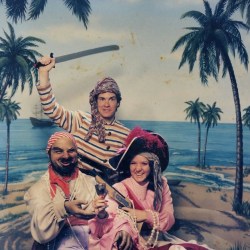
Photo courtesy of Victoria Olcott.

By the age of 19, my sister Victoria had seen the world with her mother Graciela Levi Castillo.  She was particularly fond of Italy, and early in the summer of 1982, she debuted at the Ball des Rosenkavaliers in Vienna.  Her mother was a world-class journalist and knew most if not all of Ecuador’s foreign legations from Tokyo to Rio de Janeiro.  Travel was not simply in her blood but in her work as well.  In Victoria’s case, the fruit did not fall from the tree.

There was however, just one small complication in all that itinerary planning.  Because of her mother’s antagonistic divorce from a certain New Yorker, Bernard Olcott, Graciela (not Victoria) was forbidden from landing at any US airport.  Victoria herself was born in New York from an American father.  However, she was spirited away to Guayaquil at the age of 14 months, and had never been back.   When traveling with her Mom, they were obliged to hop over the US and avoid travel hubs like JFK, Miami, or LA.

Even though technically a gringo, she grew up as a local in her native South America.  It must have been strange to have been an American – with a US passport – yet, due to no fault of her own, could not stop off in the land of her birth.  She claims it wasn’t so – to her it was fun!!!  Victoria is lots of kicks!

19 YEARS

My beguiling sister Victoria, with an admirer, sometime in the late 1980s.

As related in my post “Fear and Loathing on Second Avenue,” when I returned to New York in June 1965 for summer vacation, my stepmother Graciela was no longer there.  Dad’s third marriage had collapsed, fully and fitfully, a few months previously.  Her father had broken his hip in Ecuador that January and she had raced down there to be at his side.  From her point of view, what was the point in coming back to New York?

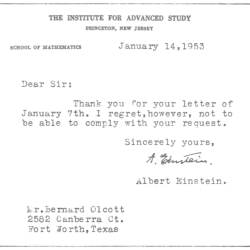
So Graciela became yet another void in my Dad’s life, one of many.  Whether it was the missing family in Lithuania, the Einstein letter, or the mystery of wife no. 1 (the one before my Mom), these black holes of his intrigued me, beckoning me to jump in.  I was learning that my leaps inside were dazzling experiences.

As for the mystery of wife no. 3, Graciela was actually one of two voids; with her on her trip home that winter was my infant sister Victoria.  I could remember her as a swaddling babe in her crib from the year before.  Little did I know that I would not see her again for 19 years!

A MAN OF LETTERS

Dad was a man of letters.  He loved to write to anybody and everybody.  Whether he was writing to one of the greatest minds of all time (Albert Einstein) or the Chief Patent Counsel of Apple Computers (Paul Carmichael), I was often astonished at the response rate (at least at the onset).

In fact, writing letters was his preferred and (for a while) just about sole marketing tactic for Olcott International in the 1980s and 1990s.  I recall that he really got started by composing a 4 page template on an Olivetti electric typewriter around 1982.  This sample letter, into which he could drop hundreds of names and addresses via mail-merge, was a direct and personal appeal to the Chief Patent Counsels of large corporations, the ultimate decision makers on the customer side.  Dad’s letters would, without much of an introduction, launch into 1) not-so-brief technical descriptions of his helicopter and air conditioning patents, 2) how he pioneered the concept of calendaring and paying patent renewals by computer in the early 1960s, and 3) how the Chief Patent Counsel’s company could save hundreds of thousands of dollars by delegating such to Olcott International.

For the convenience of the reader, I have boiled the letter down into those three sections.  In reality, it was a difficult-to-read, long, rambling, monster of a letter, replete with malapropisms.