BOOMERANG RETURNS!

Today the Bernard Olcott story returns to Vilnius, May 1985.  From my post “BOOMERANG THROWN,” you learned that I was in Lithuania for 5 days that year, hunting down my family roots.  The first day was remarkable.

My second day in Lithuania featured an old fashioned get-on-the-bus touristic outing with my Intourist group.  The destination was the town and castle at Trakai, about 30 km to the west of Vilnius.  Built in the 15th century as the home to the Lithuanian Grand Duke, it was considered as the unofficial capital of Lithuania, which, as part of the united Polish-Lithuanian kingdom, stretched from the Baltic to the Black Seas in its prime.  Today the ancient castle is in good condition – for a structure that is 600+ years old – and is scenically located on an island in a pristine clear water lake.

BOOMERANG IN THE AIR FROZEN


This blog ostensibly concerns my Father, Bernard, who passed away in 2006.  But I take many diversions along the way.  Today’s post is mostly about his 2nd wife, my Mom.  She is a spry 83 year old woman who brags about her ability to walk around the parking lot in front of her Assisted Living Residence “23 times” every day.  She is very specific about that number.

OK, so what do you do with your aging Mother when you bring her home for the weekend?  In my case, I take her for long walks.  Makes sense, right?

This past Sunday, I brought her and my cousin, Lise (visiting from Quebec City), for an excursion to the Four Freedoms Park on Roosevelt Island.  It’s a stunning modern memorial to, in my opinion, the greatest President of our Republic.  Our very own Great Leader, the handicapped patrician who led our country through its darkest hour to supreme victory and ascendancy to superpower status, militarily, economically, and culturally.  FDR.  Now we have a Washington, DC-style monument in his honor, right here in the middle of the East River.

BOOMERANG THROWN

The past 5 posts describe the first of the 5 days staying at the Hotel Lithuania (not to be confused with the Hotel California).  In Vilnius, Soviet occupied Lithuania during May 1985.  Intermingled in the details were other anecdotes about my stay in Moscow the prior week.

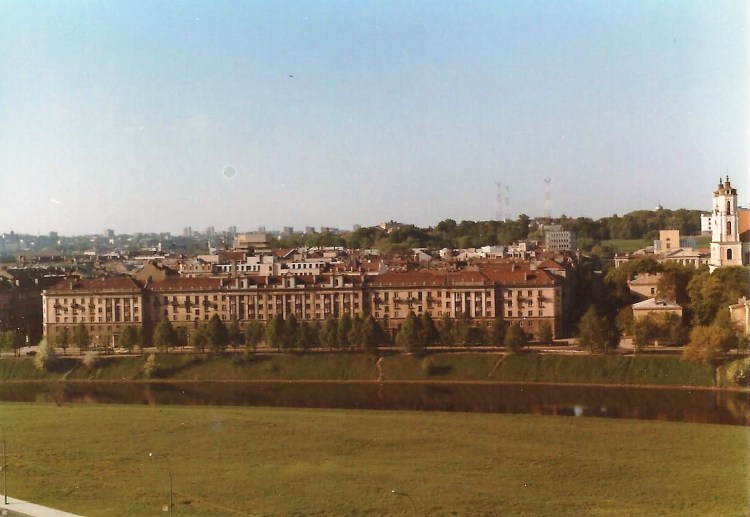
View from my window at the Lietuva

My view out the window of the Hotel Lietuva.  The Neris River is in the foreground and the Old Town behind.

For the sake of repetition, my primary purpose in going to Lithuania was to meet my Father’s family, his uncle and cousins.  Our roots in this small, little-known country in Eastern Europe was something we shared.  Plain and simple.

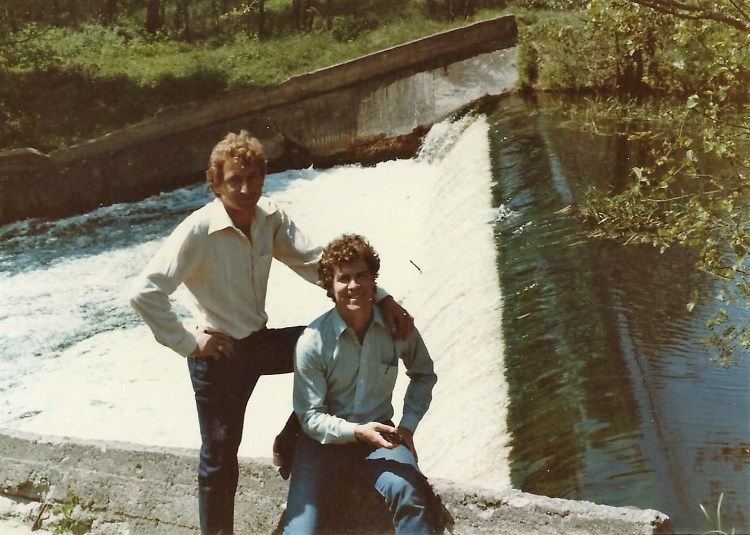
Curly Hair

The author with Eugenija’s son (and my cousin) Vytas.  At least I figured out where my curly hair came from!

When I got there, I discovered insights into what exactly constitutes oppression.  Some of it boomeranged to hit me in strange ways.

SOVIET MINDERS AND TOILETS

It had been an eventful drive from Vilnius to Varena that sun-drenched spring morning in May 1985.

First was being pulled over by the USSR highway patrol.  It looks fearsome just to see it here in writing on the Bernard Olcott story.  But Boris the driver managed not to collect S&H green stamps from the patrolboy.

Second was a stop at a World War II massacre site to learn a lesson about oppression.  A moment of irony in the USSR.

Next up was our ostensible destination, the town of Varena, Dzūkija region, in Southeastern Lithuania.   My Dad’s cousin Eugenija lived there with her husband in the old part of town.  Their broom-swept house turned out to be at the top of a T intersection, a few feet away from an ominous looking empty small guard tower.  Asleep in the tall grass at the base was a disheveled drunk, who was quickly roused and sent away.

(SOUR) LESSON OF HISTORY

Ponary Death Pit (photo courtesy of Juliux from Wikipedia – Own work, CC BY-SA 3.0)

Courtesy of my driver Boris and his lead foot, fueled by my Al Green cassette tape, our Russian Volga sedan resumed its cruise down the A4 highway towards my lunch appointment with my father’s family in Varena, Lithuania.  We had just survived a traffic stop a few moments earlier where Boris effectively told the zit-faced highway patroller to go fuck himself.  The USSR seemed to have a great surfeit of immature officers populating the police, immigration, customs, animal control, and doubtlessly numerous other constabularies.

My very first experience of the Soviet Union the previous week was instructive of this very point.  It was upon my arrival into the USSR on an Air France nonstop flight from Charles de Gaulle to Sheremetyevo airports.

It was May 1985, and, as a student of history and world politics, I was excited to be flying into a very different kind of country.  I had had some extensive experiences in Europe already, but this, the USSR was to be verily alien.  As a kicker, I would be meeting my Father’s family in Lithuania after a week in Moscow.

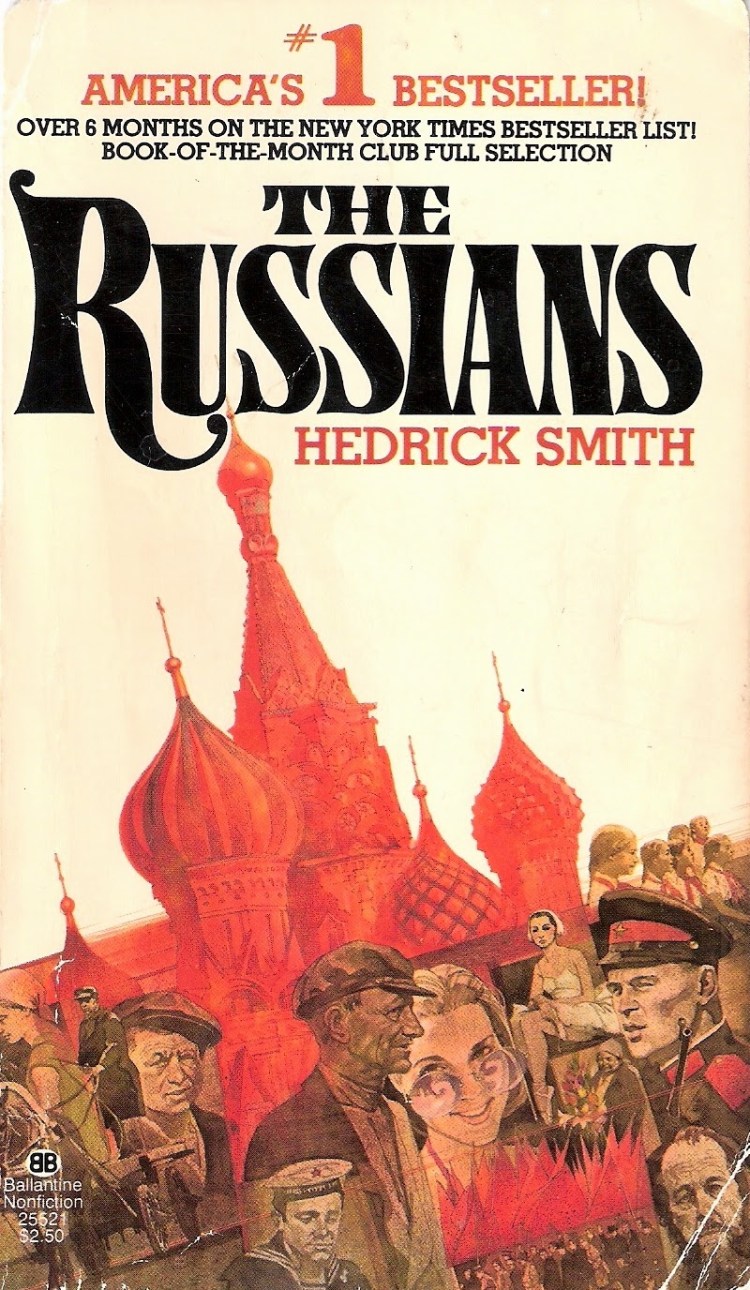
In preparation for my trip, I read everything I could about Russians (inhabitants of the world’s largest country), Lithuanians (great basketball players), and the Baltics (I would also be passing through Riga, Latvia).  Hedrick Smith’s “The Russians” had earned a prized place in my personal library, with dog-ears on the dog-ears.

IN SEARCH OF… MY FATHER’S MOTHER!

Before I cover the apparently sudden demise of my father’s mother Patricia in Queens, NY, on August 22, 1943, let me backtrack a bit and take a look at her origins.  At least the little that is known.  So I go in search of…  my paternal grandparents!

For that, my story today starts off on one beautiful bright Saturday morning in May 1985.  I was in a rental car rolling through verdant countryside.  The birds were chirping, the sun was streaming, and my Al Green cassette tape was cranking through the sound system; Al crooning “Love and Happiness.”  It was a happenin’ morning!

Yet this was not your normal stretch of New Jersey Turnpike, say between Elizabeth and Rahway.  Nor was I in a 1984 Buick LeSabre.  This road trip was distinctive for many reasons!

Well for one thing, the player’s fast forward was broken so when I got to the end of the last song on side 1, I had to eject the tape, stick my finger into one sprocket, and twirl the tape around my finger until I got to the end of side 1 (which was the beginning of side 2).

But that was just a nit.  Maybe it had something to do with the fact that I was rockin’ a recent vintage Volga sedan like the one pictured below.

MHV_ZiL_117_01

Switch out I-95, and sub-in the fact that I was rolling southbound on the A4, a rural two lane highway in Soviet occupied Lithuania.

MING AND DARTH

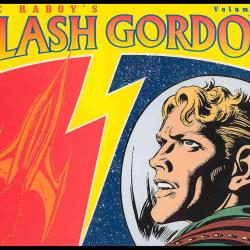
Aside from World War II and the War of the Worlds broadcast, there were other haps in the 1930s and 1940s that informed my Dad’s interests and personality.  For example, as he told me numerous times, his favorite comic strip of the era was Flash Gordon.  Flash was big at the time.  Dad loved Flash so much, it was even his college nickname!

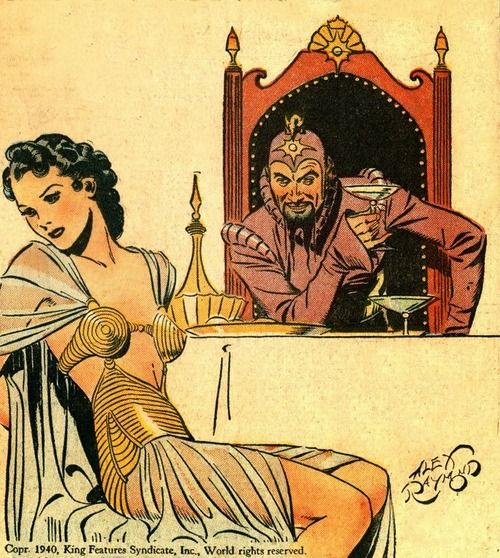
As I reviewed the original comic strip in preparation for this post, I was struck by how much it resembles Star Wars of my generation.  The action takes place on the planet Mongo, locale of kingdoms like Arboria (forests) and Frigia (ice).  Kings and Queens galore!  And the villain?  A bad guy with interesting headwear!

Ming the Merciless

Meet Ming the Merciless!

When looking at the above image of Ming, I am not sure if Darth Vader was ever so similar a lady killer.  Well, the young Jedi Anakin certainly was, in the prequels.  Unfortunately, he lost his man parts — GOP Presidential candidates please take note — on the lava planet (or moon, whichever) after losing the sword fight to Obi Wan.

On the other hand, what Flash didn’t have was the tiresome drama of Luke and Leia playing “who’s your daddy?”  Who needs parents anyway?  That’s right, you heard it asked here on the Bernard Olcott Story blog!

LEADING TO WAR

Over the past few weeks, I have written a lot about the 1940s, an era well before my time.  It was, by any measure, a very scary decade.

In my travels across Europe, I have gone looking for the remnants of World War II.  (Interestingly, none are visible in Japan, except for the gradual realization that all architecture is post 1950.)  There is the tour of Churchill’s bunker on King Charles Street in London.  Walking around Paris, you can’t help but notice the historical markers here and there memorializing the location where a patriot was shot by the Nazis.  In both cities, I have walked down certain streets and noticed numerous pockmarks on the graceful facades.¹

At times, I have looked up into the sky and tried to imagine the sounds of bombers, the rumble of artillery, or the rat-a-tat-tat of machine gun fire.  From the damage to the buildings around me, I could tell I was standing in the very places where hell reigned.  But, in every case, I failed to feel it.  Just cloudy skies above, and the sounds of traffic around me.  I could sense the highs and graces of Europe, but I just couldn’t visualize or feel the war that was very real.

The drumbeat to the war is best documented, in my opinion, in William L. Shirer’s remarkable tome The Rise and Fall of The Third Reich.  A bigoted politician – whose ancestor had fortuitously changed the family name from something sounding silly ² – built a national campaign scapegoating minorities to win an election in a major European state.  He successfully manipulated the new media of the era – radio and motion pictures – to win the adulation of the masses.³

Sound familiar?  Can’t happen here, right?

IN DEMAND, AND THEN NOT

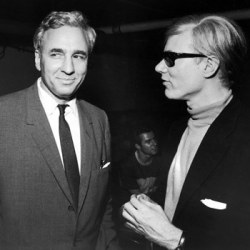
Huntington Hartford and Andy Warhol.  Photo courtesy of Vanity Fair.

A couple of weeks ago, one Sunday evening, I was driving back to my home in New York City from Hunter Mountain in upstate New York.  Most of my drive home was spent on the New York State Thruway, the major vehicular artery connecting the city to the state capital, Albany, and then on to Montréal via a continuation called the Northway.

As I approached the New Jersey border (please see my post WHAT’S IN A BORDER) driving southbound, I passed by Schunemunk Mountain on my right and then a succession of some small hills and valleys.  I also drove under a pedestrian overpass where I used to play a silly game with my children; the object of the game was to cross directly over the path of an oncoming car and get ‘run over’ (except, of course, you are on the overpass above).  Small children love this game – the direct opposite of “don’t play in traffic” – as well as parents with the mind of a small child.

Before crossing the border, I passed through a small dreary rural town called Hillburn.  After crossing, the sprawl of suburbanization was immediately palpable.

The last 20 miles took me through the northwest corner of New Jersey.  One of my favorite stops is a well-stocked A&P Supermarket in Allendale.  Not only does it feature a great selection of grocery items at low prices, but also has an unexpectedly good selection of wines.  Like 10 year old Pauillacs, perfect for drinking, which cannot be found in Manhattan (at least not 10 year old ones – damn wine bitches teefed all the good stuff).

To my surprise, I pulled up to see that the familiar A&P moniker that used to grace the façade above the front doors had been replaced by the new name ACME.  A&P, a retail business since 1859, alas, was now defunct.

It reminded me of a strange business investment solicitation my Dad received in the early 1980s.  In this case, I was not the wingman, but the paddleman.  Let me explain.

THE PROVENANCE OF DILIGENCE

The scenes featuring Gloria in “The Lost Weekend” are said to be shot in PJ Clarke’s bar, still at the corner of Third and 55th, but no longer under the shadow of the El.

It was not “New York’s New Yorkiest” joint, however, as declared by Walter Winchell, the leading radio personality of the 1940s and 1950s. That honor fell squarely on The Stork Club.

Unlike PJ Clarke’s unfortunately, nothing is left today of The Stork. Owner Sherman Billingsley was arguably one of New York’s greatest celebrities from the 1940s and 1950s. Where he once fought union pickets and sabotage, while throwing customers out (who dared to patronize the rival Harwyn club), a peaceful pocket park marks the former location of the famous glitzy eatery and bar.

There aren’t that many relics of old New York left. Probably one of the best “New Yorkiest” venues still in existence is the storied Cooper Union for the Advancement of Science and Art. It’s a puzzling institution in that many New Yorkers don’t seem to know about it. When I asked my Dad where he went to college, he told me proudly “Cooper Union” and when he noticed my quizzical look, proceeded to tell me about it.