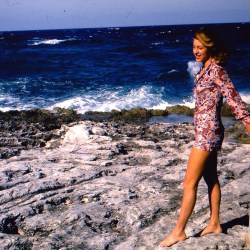
GLORIA RATES MY T & A!

Above photo by Bernard Olcott

As explained in my post SURPRISE!!!, gosh was I ever!  A new step-mom.  I didn’t really get too anxious about meeting my new step-mom because I didn’t have time – it was to be in 3 days!  Her clothes were in the closet.  She had already traveled with Dad to Brazil and Japan.  Silk wedding gowns adorned the walls.

So Gloria joined our small Olcott nuclear family.  This meant that whenever we went out for a road trip, which was often – and something I continue to do to this day between Québec and North Carolina – I had the pleasure of her company in the car.  Gloria was an excellent conversationalist.  And we tested each other right away.

DUEL AND DEATH

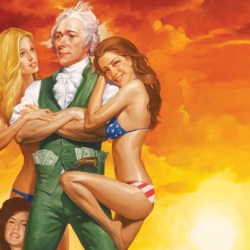
Hamilton was said to have been popular with the womenfolk. Illustration by Roberto Parada

ALEXANDER HAMILTON’S NEMESIS

One such who had no love for Hamilton was another New Yorker named Aaron Burr who hailed from the opposing Democratic-Republican Party.  The two crossed swords numerous times such as a prior duel Burr fought with John Baker Church in 1799, who was married to Hamilton’s sister-in-law.   The duel ended peacefully with Church apologizing, and soon thereafter Burr sought Hamilton’s support in funding a water company.  Unfortunately, Burr baited-and-switched Hamilton in that the new venture turned out to be not a water company at all, but the Bank of the Manhattan Company (fore-runner of today’s JP Morgan Chase Bank).  Hamilton, who already had elite bankers in his pocket, did not want a new bank carrying the flag of his opponents.   He withdrew, crying foul.

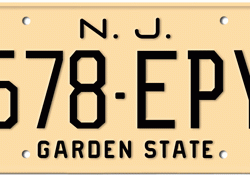
WELCOME TO NEW JERSEY!

It was mid June 1970.  I had just graduated from 6th Grade and had said good-bye to all my friends at Trinity Lutheran School in Orlando (who I never saw again spare one).  It was time to fly up to New York to be with Dad for the summer.

Mom drove me to McCoy Airport in Orlando for my flight up.  When we pulled up to the curb for Eastern Airlines departures, we looked at each other.  “Mom, do you have my ticket?”  She shouted something to the effect that she thought I had it.  We had 30 minutes until the flight left.  It was a 20 minute drive one way to get home.  “Put your seat belt on,” she said to me.  And then she hit the gas, real hard.

Traffic was moving serenely on I-4 that afternoon.  Except for one crazy lady in the brown Mercedes with the “lead foot.”  She drove hard on the left lane, up to the bumper of the car ahead.  She honked and shouted, “move it asshole!”  If asshole moved, she would race up ahead to the next asshole.  If asshole did not move, she would glance over her right shoulder, signal, and then the brown Benz would lurch over to the middle lane and race around asshole.

Not many people drove like that around Orlando.  Mom was the only one who ever honked.  I watched her masterfully maneuver the Benz like General Norman Schwarzkopf in the first Persian Gulf War; over, around, under any obstacle.  We reached our house, I raced inside, grabbed the ticket, and then back again to the car.  She roared down I-4 to chase more assholes down to McCoy.  I made the flight just in time.  I looked at my Mom with pride.  Homegirl could really bring it when needed.

WHAT’S IN A BORDER?

North of the Rio Grande River is a huge expanse of North America divided up into 49 states, 10 provinces, 3 territories, and 1 district.  Just about everywhere, the dividing lines are sleepy affairs.  No fences to block your way.  With a flashlight, you might find a surveyor’s marker under a bush assuming you knew where to look.  Typically, a sign is erected on the “border” welcoming you to the new jurisdiction.  Some places have signs to serve the opposite purpose, that is to say farewell to the hapless traveler.  In the Southern United States, it is possible to see a sign with the information “You are now leaving Bucksnort, Hurry Back!”

Technically, the most serious border crossing is the one between the United States and Canada.  When Mrs. Findlay F. Traveler from the US drives over that line, she can expect to be interrogated by overly inquisitive Canadian custom agents eager to ascertain just exactly how many bottles of liquor and cartons of cigarettes are stashed in the trunk.  Any kind of vague answer will trigger an immediate request to pop that puppy open.  A precise inventory will be taken and the requisite CDN $38.50 levy lifted from the traveler’s credit card.  This interrogation is also offered in French as a sucker ploy.  If Mrs. Traveler chooses (poorly) to respond to any question using her middle school French, the agent’s eyes will harden with suspicion and the customs’ duty tagged with a 12% nuisance surcharge.  It has nothing to do with us in the US; it’s related to some kind of internal trauma up there.  It’s best to answer everything in English taking care to ask if the border station has a gift shop where you can buy the moose tee shirt.  Knowing the system thusly, you can be waved through in under 60 seconds.

Driving back into the US on the other hand is a quick passport sniff to insure that you are really from one of the 63 entities mentioned above (or Hawaii and a few other scattered islands).

All of this is relevant to The Bernard Olcott Story because of one peculiar exception to this peaceful patchwork littering the landscape from the Atlantic to the Pacific.  One border where the crossing is associated with profundity from a logistical, emotional, and psychic (perhaps even psychotic) point of view.

A MAN OF LETTERS

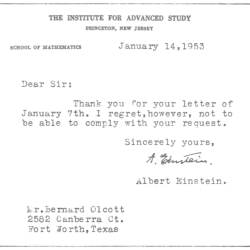
Dad was a man of letters.  He loved to write to anybody and everybody.  Whether he was writing to one of the greatest minds of all time (Albert Einstein) or the Chief Patent Counsel of Apple Computers (Paul Carmichael), I was often astonished at the response rate (at least at the onset).

In fact, writing letters was his preferred and (for a while) just about sole marketing tactic for Olcott International in the 1980s and 1990s.  I recall that he really got started by composing a 4 page template on an Olivetti electric typewriter around 1982.  This sample letter, into which he could drop hundreds of names and addresses via mail-merge, was a direct and personal appeal to the Chief Patent Counsels of large corporations, the ultimate decision makers on the customer side.  Dad’s letters would, without much of an introduction, launch into 1) not-so-brief technical descriptions of his helicopter and air conditioning patents, 2) how he pioneered the concept of calendaring and paying patent renewals by computer in the early 1960s, and 3) how the Chief Patent Counsel’s company could save hundreds of thousands of dollars by delegating such to Olcott International.

For the convenience of the reader, I have boiled the letter down into those three sections.  In reality, it was a difficult-to-read, long, rambling, monster of a letter, replete with malapropisms.

FAUSTIAN BARGAIN IN SOUTHAMPTON

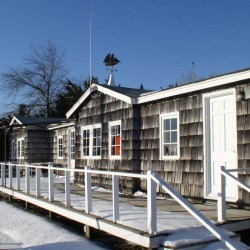
The old clubhouse.  Photo Courtesy of the Southampton Yacht Club

Last week, I related how Dad and I had our Friday schedule – pack up the Horsemobile and drive to Southampton.  A lot of people have such similar routines.  Saturdays no different.

Even the grand dame of our Southampton rooming house, Mrs. Fordham, had a weekend habit.  Every Saturday she would get together with her buddies and – I have no idea what they were drinking, rolling, or tooting – but were they up, I mean UP!, for the Lawrence Welk show at 6PM!  They were huddled together in the chairs, arranged in a semi-circle around the boob tube, simply breathless for the start of the show… Roll the bubbles…  Ah, one, two, three…

https://www.youtube.com/watch?v=6TtvbBIEIQY&feature=youtu.be

FINDING SOUTHAMPTON

After a busy week in the office of Bernard Olcott & Associates on the 33rd floor of the Pan Am building, it was time to close up shop on Friday afternoon. It was July 1966, the pavement outside was soft from the searing heat of the sun. Summertime transforms Manhattan into a tropical sweaty island, albeit with world-class dining and entertainment options.

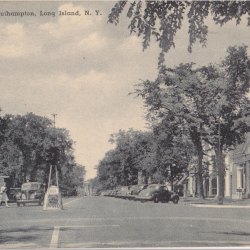
We strolled back to Dad’s large efficiency apartment at the Peter Cooper Hotel on 38th and Lexington, grabbed our stuff for the weekend, and took the 7 train out to Long Island City where Dad kept his car, the “horsemobile” – see image below – during the week. Like a Canada Goose in periodic migration, every weekend we plied our way east away from the hot shimmering city onto the Southern State Parkway until it emptied out on country roads. (This was before the Long Island Expressway was extended to Riverhead.) There, we followed Hot Water Road from Manorville all the way down to Route 27, making a left in Eastport. Through picturesque villages with quaint cottage-like storefronts, we wound our way past Katrina’s Deli (the logo was a haunting blond girl wearing a Viking-styled horned helmet), Go Kart tracks, and roadside ice cream parlors with high peaked roofs.

WITH AN MP IN LONDON 1969

After leaving New York at 9 in the morning on Pan Am, Dad and I were walking down Oxford Street, London by 10 PM, iconic black taxicabs and double decker buses whizzing by. I was hungry and saw all the burger places, just like back home. London looked like my kind of place since my diet was comprised primarily of hamburger. Dad warned me that those English burger chains like Wimpy’s were not as good as the ones back home. He was right!

And so I made my first discovery about England – the cuisine was inedible! Remember that this was 1969, before the food revolution had come to Britain and reversed the tradition of a very poor local cooking tradition – principally by boiling – made worse by the war. While in England, I suffered continuous bouts of nausea.  Once on the London tube with my Dad, I remember sitting across from a mother and her son, maybe the same age as me. He was nauseous and vomiting so I instantly was sympathetic. The only problem was that he was getting sick into a clear plastic bag.