MENTOR WANTED!

The storied history of Olcott International has been covered in detail over the last year and a half.

As you may recall from my post “THE END OF AN ERA,” the company had its origins when the proposed merger between the British patent leader Marks & Clerk and Bernard Olcott & Associates fell apart in 1969.  The partners of the former founded Computer Patent Annuities in St. Helier, Jersey, Channel Islands. My Dad founded Olcott International in Weehawken, New Jersey.  So it was henceforth a battle of the Jerseys.  Think Bayonne versus Bermuda.  (Rodney Dangerfield once boasted of his summer house in the former).

jerseys

Remember how I wrote that it was Dad’s idea that their proposed joint venture be based in the Channel Islands (to avoid Inland Revenue’s excessive tax rates in the late 1960s)?  The aforementioned partners of Marks & Clerk relocated to picturesque St. Helier setting up shop there (to reduce their tax bite).  One of the partners, Ray Chinnery, has a son my age, Martin who informed me that, thanks to my Father, he grew up in Jersey, not his native Birmingham (England, not Alabama).  Rock fever notwithstanding, Martin still lives and works there!

BUSINESS PARTNERS

The events in my last post, “TWO RABBITS, ONE DEAD,” recount the events of one bleak day in January 1995.

Everyone is entitled to a bad day once in a while.  If those events of 21 years ago had represented just one isolated blip in the story of a triumphal family saga, it wouldn’t have been that big of a deal.

Sadly, it wasn’t just a one-off but was part of a frequently distressing pattern.

It didn’t start off that way, of course, when I began my career at Olcott International a different January a dozen years before that, in 1983.

As I have written in various posts like “SOMETHING ABOUT DAD, PARTS 1 AND 2” and “HEARTBREAKER,” Dad wanted me to join the family business even though various warning signs made me ambivalent toward the idea.  After all, you should always know who your business partners are.  If they’re your parents, you don’t need to do a background check to find out.

As an example, I can perform due diligence in my case by asking a few questions:

TWO RABBITS, ONE DEAD

So after glory on trips away, say in London as described last week in my post “ODD THINGS ABOUT TRIPS,” what was life like back in the office in Weehawken?

The following story sums it up.

One day in January¹ 1995, my Dad and Olcott International CEO Bernard Olcott came down to the second floor, where I was working at the time and insisted to Steve², the lead computer programmer that a granted European Patent be placed in a list (actually, a test database) of payable items as an “EPO item.”  Now, please bear with me on the details that follow; they are important.

The problem was, once a European patent is granted and “goes national,” it is no longer payable as an “EPO item” – it becomes payable at each national patent office, like UK, France, or Germany as a British, French, German item or patent.  Only as a pending application in the European Patent Office is it payable as an “EPO item.”

Just the kind of distinction Dad loved to make.  He prided himself immensely on his profound, perhaps photographic, recall of such details for patent renewals among countries.  After all, he wrote the book on patent renewals!

In this case, though, he was oddly off.  It was unusual, bordering on the weird.

ODD THINGS ABOUT TRIPS

All pictures of holes in hand, Bobby drove us back to Kansas City International Airport for our flight back to Newark.  I remember looking out the window on our descent, seeing only white.  Suddenly, below me, the New Jersey Turnpike appeared in patches out of the murk, looking cloudy, grayish, and flakey.  It was snowing, and it looked like it had been at it for a while.  We were so low over the white roadway, I thought we were going to land on it.

From brown Kansas to white New Jersey.  To be sure it had been a kind of odd-ball trip.  Going to Kansas to take pictures of holes.  More typically, my business trips back then took me to London, which was a very different kind of experience.  For one thing, England (the tourist web site has a page for “things to do on a rainy day.”) is a very “wet” country, and I developed a liking for pints hand drawn from the draught.  No need to buy a membership – everyone was a member!

This post is about England.

MR. SWAGGER’S PUMP AND DUMP

Although my office was on the lowest of three levels, during that first year on the job, I would occasionally hear strange noises filtering down from the top floor. Often these indistinct sounds would mimic fanciful imagery like, I kid you not, cattle rustling with an occasional hoof stomp. Other times, the herd would be in full stampede. A cowboy could be heard running after them, shouting and hacking from a bad cough.

Quick reality check: the office was in Weehawken, New Jersey with a glorious view of the Manhattan skyline and the giant double helix of the Lincoln Tunnel. The latter emitted the roar of machinery, the giant soul crusher as featured in my post “THE NIGHT IS DARK AND FULL OF TERRORS.” It was very far from Marlboro country, campfires, and cowboys yodeling ah-hee-ho!”

The bumps, shouts, and herd noises were discordant and weird.  What the fuck was going on up there? Sometimes, I would climb the stairs to snoop around. At first, doors would be closed as soon as I reached the top. Sometimes, I could see out of the corner of my eye,  through a partially open door, something resembling a nose, or maybe some wrinkled skin. It was as if the stable master had asked the illegal stallion to settle down in his stall so as to hide from a passerby.

Nose and wrinkled skin? Was Dad hiding an elephant from me? Wouldn’t it fall through the floor of our ramshackle building?

PANOPLY OF SWAGGER

Pictured above, beautiful Stockholm.

Last week in my post “OF GIANTS AND DWARFS” I took you, the dear reader, back to 1966 to meet Lenny the check-forger.  But Lenny turned out to be a mere piker.  Compare him to Herby Fischer¹ – the stockbroker from American Express who churned Dad for over a million in the late 1980s.  Now that guy had a plunger.  A big one.

Strange thing was, after Dad took him to court and won, inexplicably, seeking no one’s advice but his own, Dad reinvested with Herby!  Everyone can get taken once.  But to go back to the same guy afterwards?

But Herby was ultimately not the biggest plunderer.  More about him later.

Neither gentleman made it to the letterhead of Olcott International, my employer as of 1983.  Based on the amount of cash they carried away, however, they should have — at least as cost centers.

Steven Sites¹, however, did make the letterhead.  He was on the famed pantheon of “Associates” thereon.  That meant he was a BIG, the real deal.

Soon after I started my first job, I mean, not simply a first job but one at the family business with Bernard Olcott as CEO, efficiency expert, attorney at law, certified engineer in three states, computer consultant, construction foreman, automotive engine and air conditioner mastermind, ladies’ man, and unfortunately, easy mark, a pudgy man waddled over to my desk on the lower level.  He extended his hand.  “I’m Stevie Sites,” he said.  I recognized the name immediately and stood up.  A giant had graced my stoop!

I told him that I recognized his name from the letterhead and asked him about his accounts.  I had no idea what he was about to tell me.

FIRST TEST

As I took my seat behind that wooden desk on the lower level in 1982, I began my training at Olcott International.

As discussed in numerous posts, Olcott International operates in a highly specialized field, one that most people do not understand.  My Dad had started his business in 1961 on the back of an advanced (for its time) computer program that could sort patent renewal data.

He offered this service to corporate patent owners that had live dockets of hundreds or thousands of registrations. Most of these required annual payments to maintain their validity. (Patents in the USA follow an extremely odd payment schedule, however).  After the 20th year, the patent would come to term and fall into the public domain, meaning that anyone could read the patent, make the thing (whatever it was), and sell it for a buck.

Generally, whenever I met people socially, and the conversation turned to work, describing this computer and legal-driven business quickly became a problem.  Most people have professions that can be easily pigeon-holed in simple terms, like “banker,” “teacher,” or “forklift driver.” Not I. In fact, it got so tedious for me to explain what I did for a living, I would typically bail and offer up that I was simply the hostess’ psychiatrist. Sometimes, I would even be asked if I was taking on new patients. I always made sure that I was available only on the most unsuitable night.

There are patents for all kinds of things. Some vital, like certain AIDS medications. Many are frivolous, like weird ribbing patterns on a condom. Most are a waste of money, patented by individuals for products with no commercial potential.

On the other hand, successful corporations, eg. Apple Computer, have dockets comprising thousands of valuable, revenue generating patents. Every one of them worth the $2,000 annual cost of renewal (thereabouts) annually in over 100 countries across this beautiful planet.

So what was the essence of my first job with Olcott International? Patents? No!

WHEN A CHORE IS NOT A CHORE PART 1

After a few months at 974 Boulevard East in 1970, Dad found a new location for both his residence and the offices of Olcott International.  It was in a triple decker, similar to the millions that form the housing stock of Boston and environs.  But unlike the wooden ones in Massachusetts, this was constructed out of gold brick.  According to Dad, there were three layers of outer walls.  No wolf was ever gonna blow that house down!

It was on Weehawken’s eponymous Hamilton Avenue, the road atop the cliffs.  Across the street from the house, the cracked sidewalk and the rusting iron wrought fence gave way to an expansive view of the Hudson River and the west side of Manhattan.

Dad rented the first floor for the office and staked out the top floor, the third, as the residence.  The landlord lived in the apartment on the second, sandwiched, as it were, by Olcott rentals.

For years, Dad had rented bachelor style accommodations in New York and then in New Jersey when he moved to 974 Boulevard East.  No more.  The third floor was like the Taj Mahal in terms of spaciousness compared to the cramped quarters of times past.  There were multiple bedrooms, a central hall as well as separate living and dining rooms.  As this was the top floor, the ceiling everywhere was gabled into sharp points.

And yes, there was a kitchen!  A real one!

IN DEMAND, AND THEN NOT

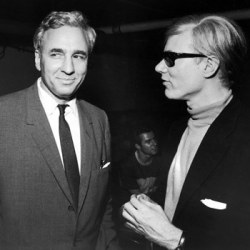
Huntington Hartford and Andy Warhol.  Photo courtesy of Vanity Fair.

A couple of weeks ago, one Sunday evening, I was driving back to my home in New York City from Hunter Mountain in upstate New York.  Most of my drive home was spent on the New York State Thruway, the major vehicular artery connecting the city to the state capital, Albany, and then on to Montréal via a continuation called the Northway.

As I approached the New Jersey border (please see my post WHAT’S IN A BORDER) driving southbound, I passed by Schunemunk Mountain on my right and then a succession of some small hills and valleys.  I also drove under a pedestrian overpass where I used to play a silly game with my children; the object of the game was to cross directly over the path of an oncoming car and get ‘run over’ (except, of course, you are on the overpass above).  Small children love this game – the direct opposite of “don’t play in traffic” – as well as parents with the mind of a small child.

Before crossing the border, I passed through a small dreary rural town called Hillburn.  After crossing, the sprawl of suburbanization was immediately palpable.

The last 20 miles took me through the northwest corner of New Jersey.  One of my favorite stops is a well-stocked A&P Supermarket in Allendale.  Not only does it feature a great selection of grocery items at low prices, but also has an unexpectedly good selection of wines.  Like 10 year old Pauillacs, perfect for drinking, which cannot be found in Manhattan (at least not 10 year old ones – damn wine bitches teefed all the good stuff).

To my surprise, I pulled up to see that the familiar A&P moniker that used to grace the façade above the front doors had been replaced by the new name ACME.  A&P, a retail business since 1859, alas, was now defunct.

It reminded me of a strange business investment solicitation my Dad received in the early 1980s.  In this case, I was not the wingman, but the paddleman.  Let me explain.

THE PROVENANCE OF DILIGENCE

The scenes featuring Gloria in “The Lost Weekend” are said to be shot in PJ Clarke’s bar, still at the corner of Third and 55th, but no longer under the shadow of the El.

It was not “New York’s New Yorkiest” joint, however, as declared by Walter Winchell, the leading radio personality of the 1940s and 1950s. That honor fell squarely on The Stork Club.

Unlike PJ Clarke’s unfortunately, nothing is left today of The Stork. Owner Sherman Billingsley was arguably one of New York’s greatest celebrities from the 1940s and 1950s. Where he once fought union pickets and sabotage, while throwing customers out (who dared to patronize the rival Harwyn club), a peaceful pocket park marks the former location of the famous glitzy eatery and bar.

There aren’t that many relics of old New York left. Probably one of the best “New Yorkiest” venues still in existence is the storied Cooper Union for the Advancement of Science and Art. It’s a puzzling institution in that many New Yorkers don’t seem to know about it. When I asked my Dad where he went to college, he told me proudly “Cooper Union” and when he noticed my quizzical look, proceeded to tell me about it.