DESCENT INTO RETAIL

The Fall of 1988 was a troubling, uncertain time for me.  Sure, I resented Dad’s fantastic and intriguing family business not being my safe haven.  For reasons that well transcended any sense of fairness, I was now nevertheless physically apart from it.  It was a brutally hard decision.  And now, after the herculean effort of getting an MBA, the stock market crashed on me and the recruitment season at Columbia was a bust.  The demand for Wall Street jobs among my classmates and me well outstripped the supply.  I was on the wrong side.  End of story.

However, my relationship with my Dad was much improved since I had left the company on that infamous “DATE OF RECORD” of August 18th, 1986.  My Dad was just one of those people who needed to tie people up to a whipping post so he could lash the poor slobs constantly.  It’s kinda like our President; he is almost lost if he doesn’t have Hillary as a constant target.  (Incidentally, I am struck by how she has disappeared from public view.  Maybe former President Obama can pitch in?)  Over the years, I have known a few people like this.  Do they realize what they do?  I am not sure.  In my case, leaving Olcott International effectively removed me from the line of fire.  That sure worked for me as I had long come to tire of spitting out lead.

So this is the tale of my descent into the retail wilderness.  I became a “Polocaust” survivor.  Let me explain.

RUNNING OF THE BULLS

As an MBA business school student in the fall of 1987, in the middle of a raging bull stock market, I was in receipt of a very strong sell signal. In all honesty, I had been for a long time.

Was it from Herby Fischer, my own (and Dad’s) stock broker? (I had a very small account with one holding, Wix, which promptly went down after Herby bought it for me).  No.

Was it from Ira KawallerJimmy Rogers, Jim Freeman, John Whitney or any of the other great business school professors at Columbia Business School? Nope.

How about my pal, Arch Crawford, the famous stock prognosticator who predicted future DJIA index levels by Astrology? Nice try. But wrong.

Ok. Ya think the source could have been someone who had no experience whatsoever in portfolio theory, Elliot wave, or value investing? Someone who never quoted Peter Lynch, Warren Buffet, or even read Alan Abelson’s column in Barron’s?

Yes, it was. None other than the namesake of this blog. My own Dad, Bernard Olcott. Only problem was, he was predicting that the stock market was going to crash. Every. Single. Day. So each evening, I would review the financial news and remark to myself, boy oh boy, that stock market just keeps climbing like gangbusters!

FALLING SKIES

Last week, I discussed cataclysmic instances of a falling sky.  Once every six billion years or so, you don’t want to be here (on Earth).

In the interest of full disclosure, there are other instances of falling sky which are not quite so universal, but just as terminal on a local basis.  Consider a neighborhood volcano that explodes.  Forget about ancient times like Mt. Vesuvius wiping out Pompeii in 79.  That’s year 79, not 1979.  How about the city of Plymouth, Montserrat in the West Indies (I used to renew trademark registrations here!)?  Founded in the 18th century, it served as the capital of this British Overseas Territory in the Caribbean for over 200 years.  Until it was wiped out by the Soufriere Hills volcano in 1997.  Today Plymouth is a ghost town, population zero.

My favorite “sky is falling” incident is the one that occurred in Peekskill, New York on October 9, 1992.  Earlier that week, a resident of that fair city, 18 year old Michelle Knapp scraped together $300 to buy her first car, a 12 year old used red Chevrolet Malibu.  She must have been excited to drive her prize back home and park it proudly in her driveway.

chevrolet-malibu-1980-1

Introducing Chevrolet’s 1980 Malibu. 

CHICKEN LITTLE

Above illustration courtesy of Mabel Hill – http://www.romanceroundtable.com/wp-content/uploads/2009/01/barnesreader07.JPG, Public Domain, https://commons.wikimedia.org/w/index.php?curid=10806723

Chicken Little was annoying for at least two reasons.

For those of you reading this blog from overseas, perhaps you may know this little fluff ball and the associated folk tale as Henny Penny or Chicken Lichen.

By way of review, the story goes like this.  Chicken Little (or Henny Penny) was a chick outside somewhere, probably in New Jersey, when all of a sudden she was hit on the head by a falling acorn.  Her gut reaction was to conclude that the sky was falling and that the king would benefit from a warning of this “fact.”  So, she embarks on an epic journey and persuades all that she encounters that, indeed, the “sky is falling.”  In this way, she is joined by other feathered friends like Ducky Lucky, Cocky Locky, Gander Lander, and so on.

Eventually, the flock encounters a clever fox who listens attentively, and then invites them all to his lair for some refreshments.  This turns out badly as the fox simply latches the door and devours them all.

In some versions, Cocky Locky manages to warn Chicken Little who escapes and lives happily ever after, most likely ending up in an EconoLodge outside Newark.

But I digress.

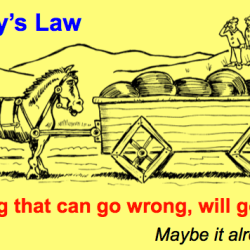
MURPHY AND HIS LAW

This week’s post is dedicated to Carrie Fischer, who was a tremendous advocate for victims of mental illness.  Despite tremendous hardship and emotional neglect, she became the sole caretaker of her father Eddie Fischer during the last years of his troubled life (divorced 5 times!) in a completely selfless manner.

carrie_fisher_2013

Brown Brothers Harriman.  Manny Hanny.  Cantor Fitzgerald.  First Morgan Sachs Fifth Avenue.  Taco Bell.  If Michael Lewis wrote about them, I interviewed there in my search to get out of a destructive work and family situation.  Like Horatio Alger‘s characters, I needed a powerful mentor to groom the trail ahead.  Lacking such, my quest was doomed to heartache.

Nevertheless, I did find many helpful folks along the way; it was just they were never in the right place to clear an obstacle for me.  Even though somewhat underpowered, I tried to compensate by being as thorough and complete as possible.  For example, an unusual source for job leads was to be found in the salmon pink colored folds of the Financial Times of London.  I knew this paper from my frequent trips to England.  There was a recruitment section on the back pages.  I answered lots of postings and bought sheets of international air mail stamps to send out my resume.

Occasionally, I received a courteous reply thanking me for my application.  Invariably, they promised to contact me promptly if “a suitable match were found.”

I watched the backs of pigs anxiously for any signs of wing buds.  But like watched pots that never boil, I couldn’t get my bacon to fly.

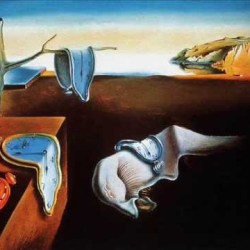
PERSISTENCE OF MEMORY

Most people think that working in a family business is a privileged position.  I can’t blame them for thinking that.  I have the impression myself that many are.

I wish that mine had truly been of that fortunate variety.

But it wasn’t.  My Dad just wasn’t the kind of person that you would want to work with, ever.

It was not solely because he was a nitpicker of the nth degree.  Or a micromanager who would agonizingly complete the job poorer than you.  Generally, such kind of people are insufferable to work with and are to be avoided like the plague.

Sadly, it went beyond that.

Maybe it was all due to his childhood experience of being second-place to an over-bearing older brother.  Or his troll of a father.  A mother who was overwhelmed by trying to shelter that older brother from the fault-finding excesses of her Stalin-duped husband.  Accordingly, one Sunday morning in 1943, she got up out of bed, had a cup of coffee, and expired, all by 11AM!

Could have been just a character flaw, plain and simple.

KANGAROO COURT

Bernard Olcott (my Dad).  Bob Gerhardt.  John Dennemeyer.  Gerald Van Winter.  Ray Chinnery.  These are the founding fathers of the global Patent Annuity industry in the 1960s and 1970s.  And beyond!

Most everyone credits my Dad with being the first to figure out how patent maintenance fees could be tracked and organized by a computer-managed and calendaring program.

All were known for their strong personalities.  Some say you need to be somewhat difficult and egotistical to overcome the inertia of the status quo and take the business world by storm with a new idea.  Certainly this was true for Steve Jobs but maybe not so much for Bill Gates.  Perhaps personality isn’t everything.

Not to say that Bill lacked a strong character, just that he didn’t have the same reputation for going off the rails.  Maybe his penchant for the pleasantries of networking and interpersonal skills of collaboration was truly the road ahead.  I dunno.  I just report.  You decide.

Putting some of these guys together certainly was a recipe for making fireworks.  Apparently, my Dad and Ray Chinnery didn’t mix so well.  If I ever saw them together, it was during a two week period in London over the summer of 1969.  And that was that.  Never again.

HIS NAME WAS BOB GERHARDT

Sometime in late 1984, I drove out with my Dad to Newark Airport in his clunky 10 year old Mercedes Benz, the engine duly defanged so as to economize on the high cost of gas.  Dad wasn’t a great driver.  Driving with him was like taking a safari through cannibal-infested badlands.  His signature move was to pull out into highway traffic much too slowly to the taste of neighboring motorists, due either to the underpowered engine or his “hell-can-care” attitude — pick one.   Invariably, this would provoke generous amounts of honking and obscene gestures.  Massive flocks of New Jersey state birds (“boids”) arose quickly all around us, “wings” fluttering, taking flight quickly into the air.

In other words, New Jersey drivers set their alarms to 3AM so they can wake up and hate that kind of driving.  Across the river in New York, you would likely hear howls of “yer driving be stank, yo!”

Dad loved gratuitous comments about his driving.  NOT.  He certainly wasn’t shy about responding in turn.  Loudly.  Often at those moments, I wished I could disappear.  Or get beamed up.

But this trip to James Riddle Hoffa Memorial Airfield (a/k/a Newark Airport) was not a run-of-the-mill journey.  We were on our way to meet and pick up one Robert B. Gerhardt, a founding father of Master Data Center (“MDC”)¹, a leading competitor to Olcott International.  Bob was a veritable Giant in the Patent Annuity business space.  He was flying in from Detroit to discuss joining up with us.  A strategic spear to be thrust deep into the sides of our competitors, not just MDC, but also CPA and CPI.

MAYBE THERE WAS HOPE!

As relayed in my previous post, “TWO RABBITS, ONE DEAD,” by the early to mid-1980s, the Patent Annuity payment business had evolved to the point where corporate patent owners had lost interest in a basic renewal service. (See my post, “THE BIGGER IDEA (AND ME AS WINGBOY)” for a basic explanation.) What they did clamor for, however, was software to manage their patent files and operations.

These patent departments were awash in paper! They desperately needed to computerize their operations.  By converting paper to electronic files, they could junk their antiquated manual reminder systems. In other words, it was time for them to turn their operations into a modern computer-managed process.

A cheaper and more efficient renewal payment service just didn’t set any bridges on fire anymore.  At least, not like it had in the 1960s. Disruption had moved on.

Dad was extremely resistant to extend the Olcott International brand to a marketable piece of software.  That would have entailed restructuring his business to meet the emerging disruption (please review Rebecca Henderson and Clay Christensen, disruptive innovation experts at the  Harvard Business School).  Dad now confronted the same disruption challenge he had once imposed.  To respond or not; to react incrementally or radically?

disruptive-innovation

At the time, I was of limited help in addressing this existential threat as I was completely computer illiterate.  We did have some kind of mini-computer in the basement that kept our clients’ patent data on big removable disk drives.  (We had off-site storage facilities to prevent loss from fire, Bigfoot, or nuclear attack).

MY FRIEND IN JERSEY

Astute readers will notice that, in the last few posts, I have been jumping back and forth from the 1980s to the 1990s and back again.  At the core of these stories is my conflicted search to reconcile my Father with the very different man in front of me.  After all, parents are our archetypes.  They are part of us.

I simply couldn’t believe what I was seeing when I started working in the 1980s.  It was convenient to ignore or turn a blind eye to Dad’s episodic incongruent behavior, especially at first.  Back then I was young and inexperienced with no idea of what happens in offices around the world.  People can be strange sometimes and certainly this can be reflected in the workplace.

Now, in 2016, as an IT consultant, I can look back at my career.  I have worked in more than 26 companies from Polo Ralph Lauren to Heineken to AmerisourceBergen to Mitsubishi.  I have had my own desk in Ankara, Tokyo, Sydney, Prestwick, and Totowa (New Jersey).  Without a doubt, what I witnessed in Weehawken during the 1980s and 1990s was truly staggering.  And that’s leaving aside the emotional component that my bullying boss was my cherished parent!  The man who took me to the heights of the heliport, England, and exclusivity.