SURPRISE!!!

It was early summer 1971.  School was out.  Time for my annual flight from Orlando to New York, uh, I mean New Jersey.  I rode the plane up North like a nice person (as usual).  Disembarked at the brand new terminal at Newark Airport.  Ran into my Dad’s arms.  We got into the car.  Everything normal.

“How was your flight?” Dad asked as he tried to merge into the right lane, some angry driver honking furiously.  I looked to my right to see a cobra-faced man spewing venom in the car next to me.  Reflexively, I turned my gaze away, out the front.  A flock of New Jersey state birds let loose and took to the skies.

“Great,” I lied.  Seventh grade had been a tough year at Trinity Prep School, my new school that year.  What exactly had been “great” was that it was summer vacation and it was over.  On the last day of class, everybody had tossed their books to Hoe Brown, the class beast, who manually tore up each one into several strips of paper.

“How are things with you?” I asked.

Dad grinned.

He ignored my question and said, “I have something to tell you.” He looked at me for a moment.  We had survived the merge okay and were headed northbound on the New Jersey Turnpike, toward the glistening swamps and after that Weehawken.
DUEL AND DEATH

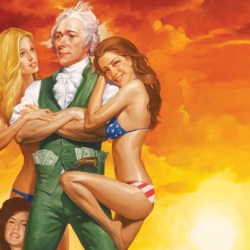
Hamilton was said to have been popular with the womenfolk. Illustration by Roberto Parada

ALEXANDER HAMILTON’S NEMESIS

One such who had no love for Hamilton was another New Yorker named Aaron Burr who hailed from the opposing Democratic-Republican Party.  The two crossed swords numerous times such as a prior duel Burr fought with John Baker Church in 1799, who was married to Hamilton’s sister-in-law.   The duel ended peacefully with Church apologizing, and soon thereafter Burr sought Hamilton’s support in funding a water company.  Unfortunately, Burr baited-and-switched Hamilton in that the new venture turned out to be not a water company at all, but the Bank of the Manhattan Company (fore-runner of today’s JP Morgan Chase Bank).  Hamilton, who already had elite bankers in his pocket, did not want a new bank carrying the flag of his opponents.   He withdrew, crying foul.

HIS NAME WAS ALEXANDER HAMILTON

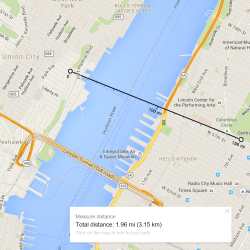
In 1970 Dad was happy with his relocation to Weehawken for tax and rent reasons.  As can be seen from the map above, his new home was less than 2 miles from the New York Athletic Club.

However, there was just one teensy little problem.  He literally could not get there from here.  Two miles away, true, is considered generally to be very close.  Assuming you can find your car keys, you can cover that distance in less than 5 minutes in most places in America.  Except from Weehawken to New York City during dining, drinking, and playing hours.

Dad tried, of course, to pop over to his old stomping grounds in Manhattan as usual.  And fatigued of it fairly quickly.  The traffic and parking turned out to be too much of a nightmare.  Thus, I imagine that Dad felt a little cut-off.  I am sure that he tried the Irish pub downstairs when he felt like “catting around” but found the local talent to be lacking.  He never went there with me or mentioned it to me, ever.

THE HEIGHTS OF EXCLUSIVITY

3 East 53rd Street, back in the day.  Today this location is an attractive pocket park with a water fall.

Of all the gin mills on this planet, Humphrey Bogart got thrown out of this one in New York City in the 1950s.

You see, the owner Sherman Billingsley was “the man” of his times, the arbiter of who was in and who was out. His bar and restaurant, The Stork Club at 3 East 53rd Street, was the most prestigious nightclub in the city, frequented by celebrities, royals, sports figures, debutantes, and café society (except Bogey and a few other blacklisteds). Black tie (or military dress uniform) was standard wear, any night.  The bartender’s name was “Cookie.” Female patrons were given a small vial of “Stork Club” perfume and flowers. Also for the ladies, Sunday night was the balloon party; balloons would drop from the ceiling at a preset time filled with presents like folded $100 bills. If you needed a ride home, Sherman had a private car for use by preferred guests. Regular patrons received a case of champagne as a Christmas present every year. As he told his employees, “If you know them, they don’t belong in here.” There was a 14 karat gold chain at the entrance; if the doorman unclipped it for you, you were admitted.  Just don’t misbehave.

If there hadn’t been a Stork Club in the 1950s, you would be reading something else right now. Because that is where my Mom met my Dad sometime around 1954.

My Dad and Mom had interesting paths to that gold chain. Since Dad wasn’t high-born, he had to get there the hard way.

TALE OF TWO IMMIGRANTS

In the mid-1950s, Michele Rousseau was a beautiful, elegant girl working at Wally Findlay Galleries on East 57th Street. She was barely 20 when she was dragged out yet again one night to the Stork Club on East 53rd Street by her extroverted mother. There she met a handsome man in a uniform and her life would be changed forever as she would soon become wife no. 2.

I know more about Michele than any other wife for one simple reason. She was my Mom.

Like my Dad’s family, she was part of a family of immigrants. On both sides, my grandparents were foreign-born and had deep ties to the Old World. But on just about every other social, economic, or cultural basis, there the similarities ended. Whereas my Grandfather Mikas Arlauskas made the arduous sea voyage literally in steerage class in 1914 from Europe to New York, my Grandmother Marguerite Alain did the trip in first class in the other direction some ten years later to be married off to her fiancé Paul Rousseau in Paris.

Later on in 1948, my Mom arrived in New York, probably in her stepfather’s Cadillac, the hood hot from plying the New York State Thruway from Montréal.

THE BIGGER IDEA (AND ME AS WINGBOY)

So Dad got the idea for a fantastic business related to patent filings and infringements, kind of an amalgam between legal and IT but not a legal practice, strictly speaking.   As I am able to remember it, he had become friendly with Ed Greer, who was head patent counsel for the Union Carbide Corporation. Union Carbide was one of the biggest chemical corporations of the day and was headquartered in their own magnificent skyscraper two blocks up Park Avenue from the Pan Am Building.

It was a probably a simple matter for Dad to put it together that large corporate patent owners could benefit from some form of computer calendaring.

Keep in mind that a large company like Union Carbide owned a large portfolio of patents. They would initially file patent applications in the home country, USA for Union Carbide. And as they were a large multinational corporation selling their wares everywhere, once the patent applications were accepted here at home, they would then engage in an international filing program elsewhere, typically the largest 15 countries in Western Europe and then Canada, Japan, Australia, New Zealand, and maybe Brazil and South Africa to boot.

DAD’S REAL WIFE

This week we go into why my Dad is famous, at least in the patent profession. The next three posts are about his greatest number one hit in the charts. And it’s big!

As you know by now, dear reader, Dad was married five times to five different women. But in a certain way, Dad was really only married once. It was not to a lady wearing a dress and lipstick (though there were more than a few of those around) but to a business soon to be called “Olcott International & Co.” It was his life, and his masterpiece, just as the Mona Lisa was to Leonardo da Vinci. (He greatly admired Leonardo and thought of himself easily as da Vinci’s equal). He could share this one true wife with no one and he guarded her with a jealous Latin-blooded fury. (As I and others would haplessly come to learn).