WHEN A CHORE IS NOT A CHORE PART 1

After a few months at 974 Boulevard East in 1970, Dad found a new location for both his residence and the offices of Olcott International.  It was in a triple decker, similar to the millions that form the housing stock of Boston and environs.  But unlike the wooden ones in Massachusetts, this was constructed out of gold brick.  According to Dad, there were three layers of outer walls.  No wolf was ever gonna blow that house down!

It was on Weehawken’s eponymous Hamilton Avenue, the road atop the cliffs.  Across the street from the house, the cracked sidewalk and the rusting iron wrought fence gave way to an expansive view of the Hudson River and the west side of Manhattan.

Dad rented the first floor for the office and staked out the top floor, the third, as the residence.  The landlord lived in the apartment on the second, sandwiched, as it were, by Olcott rentals.

For years, Dad had rented bachelor style accommodations in New York and then in New Jersey when he moved to 974 Boulevard East.  No more.  The third floor was like the Taj Mahal in terms of spaciousness compared to the cramped quarters of times past.  There were multiple bedrooms, a central hall as well as separate living and dining rooms.  As this was the top floor, the ceiling everywhere was gabled into sharp points.

And yes, there was a kitchen!  A real one!

MY DAD’S BUDDHIST WEDDING!!

In 1983, Rosemary Egan was a nimble 32 year old brunette who worked the rigging (or the galley) as a crewmember of a 282 foot Windjammer sailing vessel that plied the aqua waters of the Bahamian outer banks.  This was not just any sailing vessel, but a real barkantine, a three-masted ship, square-rigged on the foremast and fore-and-aft-rigged on the other masts.  Up to 30 guests paid for the privilege of waking up in cabins to the sound of sea birds, feasting on lobster, hammocking in the rigging, cannonballing into the ocean and participating in the sailing.

When not hoisting a jib, Rosemary could be found singing and dancing in off-off-Broadway productions.  Show tunes were a specialty of hers.  And if not sailing, singing, or dancing, she had a steady part-time gig as a Medical Assistant.  It’s good to have multiple options.

You could say that she fit a certain profile.

One day after completing a cruise, she was waiting in line to check her luggage at Nassau International Airport for a return flight to Newark, New Jersey.  Born in New York City, she had moved with her folks to Plainview, New Jersey as a youngster during the exodus out of the city proper in the 1960s and 1970s.  Please see my posts “THE END OF AN ERA” and “WELCOME TO NEW JERSEY.”

As she struggled to move her luggage towards the check-in, a handsome stranger who resembled Jack Lord of Hawaii 5-O stepped in to help.  He was awfully chatty and his eyes lit up when he learned that she was part of the crew for Windjammer cruises.  He lifted her bag onto the check-in scale with utmost care and she watched her bag carted away into oblivion as it was promptly lost by the airline for days.  It was an omen of things to come.

HEARTBREAKER

July and August 1992 were interesting times at Olcott International.  I was busy coordinating marketing activities with fellow employee Peggy.  My sister Blair also joined the company for a couple of weeks as she was out of college for the summer; I welcomed her company in yet another attempt to curtail or document Dad’s occasional onslaughts of wild behavior.

Like the time in July 1989 out of the blue one morning he assigned at the last minute a “chore” for me: move 25+ heavy (40 pounds each) 3 x 3 stacks of heavy tiles around the family summer house in Shinnecock Hills, Long Island.  It was beyond my ability.  But no matter.  Later that afternoon, he hunted me down at a friend’s house by telephone to tell me I was disinherited.

Dad was like that.  Apparently, it ran in the family.  Remember my Uncle Ed who out of the blue would also assign overbearing tasks to my cousin Billy and berate him if left uncompleted?

But back to Peggy.  She was a good soul who had a lot of previous experience with legal software and easily did her share of (in this case appropriate) heavy lifting in terms of marketing and support.  At the time, Olcott International sold various versions of patent management software, including ones for DOS, Windows, and Mac!  I learned, and trained clients in, all of them.

The Mac version was a real curiosity.  No one else had it!  Apple’s patent department in Cupertino was definitely intrigued; apparently, they were managing their patent data on a Windows platform, much to their and Steve Jobs’ chagrin.

But in the middle of this patent management business drama appeared a man much like Huntington Hartford or Bobby Edwards.  Out of the blue and completely unexpected.

But in this case, Dr. Wilson Greatbatch was the real deal.  An inventor’s inventor.  The man who had created the pacemaker and who was now going to cure AIDS.  What was he doing in the Weehawken, New Jersey offices of Olcott International?

FROM HAWAI’I WITH LOVE

Notifying a distant family member of the passing of one of their own in the Aloha State is one of the least favorite tasks of the Office of the Chief Medical Examiner of Honolulu County, Hawai’i.  It’s typically done by telephone; calls are made in the morning local time to account for the time difference back on the mainland.

The script is very simple and to the point.  “This is Betty from the Medical Examiner’s Office in Honolulu, Hawai’i.  Mr. Olcott, I’m very sorry to inform you that your brother has died here in Hawai’i.”

In Edward Olcott’s passing, an additional explanation was necessary.  “Your brother passed away last week.  I apologize for the delay in notifying you but we were unable to identify your brother because he expired on the street and was found without any identification.  We surmise that his wallet was stolen when he died.  We had to send his fingerprints to the FBI and we just got the results back this morning.”

Next are the questions about medical history.  “Did your brother suffer from heart disease?  Did he use drugs?”  These are used to confirm the autopsy results.  In Ed’s case, it was a heart attack.

Finally, the key question.  “How will you be taking care of funeral arrangements?”
Now that involves potential cost to the family member answering the phone.  Bernard Olcott never liked to be left with the bill.  He liked it least of all when stuck with the check from the person he had fought so much over so little.  His own brother.

DEATH IN HONOLULU

There is a good reason why the Bernard Olcott Story, every so once in a while, makes a reference to the Aloha State.

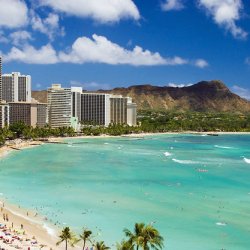
On a late July 1977 morning, a slight man woke up in his modest efficiency apartment near Waikiki, the tourist district of Honolulu.  He was 61 years old, somewhat gaunt, barely five foot seven.  Wrinkles of a hard life lined his face as he switched on the radio after leaving his bed.  The weather forecast came on, as if it were the news.  For Honolulu it isn’t, since the weather is always the same, day in, day out.  Highs will be in the low 80s, lows in the middle 70s.  Winds are “trade.”  Winds are always trade in Hawai’i (unless a cyclone comes to visit, of course.)

The weathered man had lived some thirty years previous at 3169 Alika Avenue in the Nu’uana – Punchbowl neighborhood, an up country residential district.  The previous week, he had decided to travel from his current home in Exeter, New Hampshire to come back here to retrace his steps as a young naval officer and maybe plumb his soul.  It’s about the longest trip you can make in the USA and still remain in the land of the free.

He found himself later that morning on Ala Moana Boulevard wandering alone in the sunshine on Wednesday, the 26th of July in 1977.  As Honolulu is the southern-most metropolis in the nation, at these latitudes, the sun can cause a bad sunburn in as little as 15 minutes.  The fair skin of a new arrival from Northern New England is at particular risk.

The man stopped in his tracks, his pace suddenly unsteady.  As he wiped the sweat off his forehead, the traffic swirled around him and he became disoriented.  It wasn’t the bright sun that had gotten to him, but a sharp pain in his upper chest.  He gripped himself, but could only stagger forward and reach out vainly with his free arm.  When he dropped to the pavement, he cut his face on the sidewalk.  His last sight on this planet was the passing traffic – buses, trucks, cars – from ant level.

As the dying man went down, passersby unknown took advantage of his incapacity, rapidly relieving him of his wallet, cash, and watch.  By the time help arrived, the corpse on the sidewalk could no longer identify himself.

The Honolulu County Medical Examiner later that day fingerprinted “John Doe.”  A match came back the next day – from military records.

The man’s name was

THE BIGGER IDEA (AS TED’S WINGMAN)

As recounted in my last post ‘THE INTERSECTION,” Dad went back to the patent drawing board in 1998 (at the young age of 80).  He was intrigued by various developments in the America’s Cup race, and as a new member of the New York Yacht Club, he set out to prove his bona fides both as a sailor and as an inventor.  Accompanied by his usual gusto for going with what he knew.  Natch.

By 1998, there had already been four America’s Cup races since the New York Yacht Club lost it in 1983.  A new challenge was pending in 2000 and Dad wanted in.

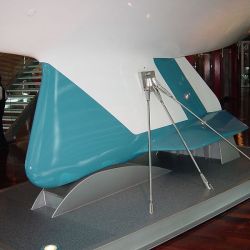
The race in 1983 had been won by the yacht Australia II due to its specialized keel design.  In fact, when the boat was first brought over from down under, the keel was physically shrouded so that no one could see it!

What was the big secret?

THE INTERSECTION

On West 44th Street in midtown Manhattan, a few doors down from the Harvard Club, stands a stately landmark building.  Designed by the architectural firm of Warren and Wetmore – the same team that did Grand Central Station – the façade features both Beaux-Arts and nautical styles.  Three magnificent windows to the left of the entrance are crafted to resemble the sterns of 18th century galleons.

Lights pour in through those windows to illuminate one of the most curious chambers in the metropolis.  It’s a grand room where more than 150 years of sailing history is preserved.  Specifically, the main exhibit documents the competition for the America’s Cup sailing race from the first event in 1851 up to the present.  In each regatta, a replica of the American boat, known as the defender, (from the New York Yacht Club up until 1983) is presented alongside the main competitor, the challenger, always English (at least at the beginning).  The determining factor for the victor is not indicated but is usually visible.

As long as you know where to look.  Dad did.

MY DAD INVENTED THE INTERNET

Well, not exactly.  But he did, in the 1950s, come up with the idea under which a majority of equity and debt trades today are effected in current financial markets.  Not that the markets followed his proposal at the time.  Far from it.  But with this idea, my Dad did actually see around the corner.  Let me explain.

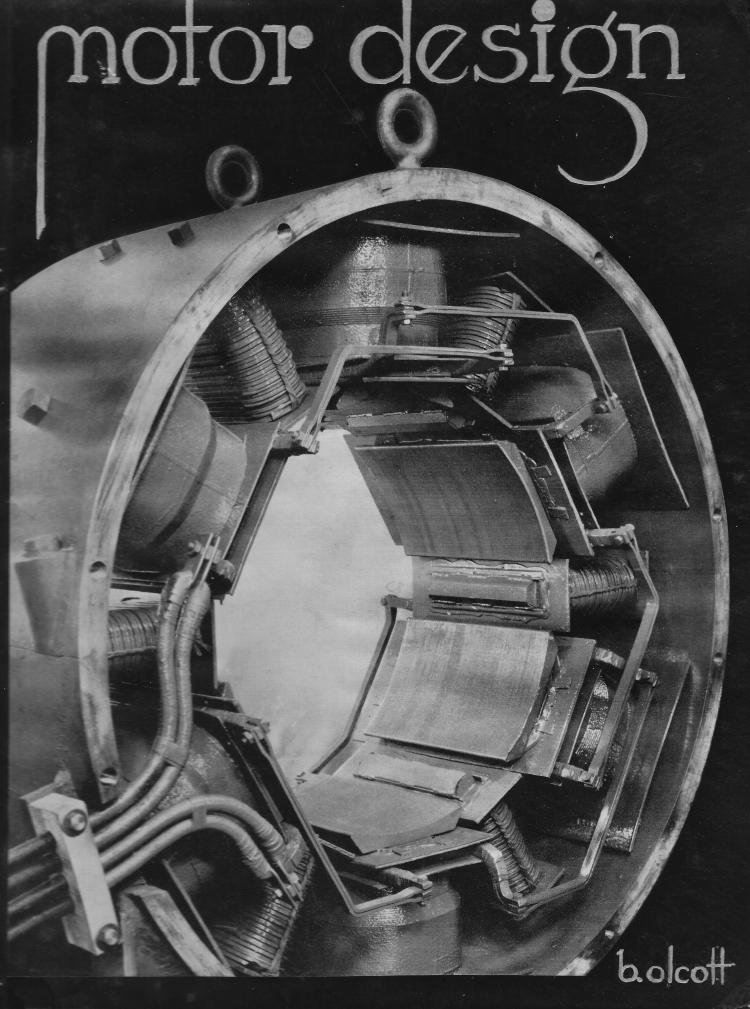
Dad was essentially an inventor at heart.  This is what engineers do, conceive of new things. As People’s Exhibit No. 1, consider the following work:

Motor Design Cover

This is the cover of a treatise entitled “Motor Design.” It was his final project for his first year at Cooper Union.  Dated May 18, 1938, it concerns engines for boats.  Of course boats!  What else would a waterman write about?

LAST CALL FOR EDWARD

Sun.  Sea Spray.  Hull smashing through rows of swells.  The ship’s deck heaving from and dropping into an endless parade of oncoming waves.  Turn your face towards the sun and catch a million dancing reflections on the water glistening back at you.

If you’re on a sailboat, there is no engine noise, just the sound of wind blowing through your hair.

Both Olcott brothers were watermen, even though they were descendants of the landlocked Dzūkija region of Lithuania.  I am a waterman too, raised on many afternoons of sailing on Shinnecock Bay, Long Island during my young summers in the 1960s with my Dad.

However, by the age of twelve, I had discovered a simple way to elevate the pleasure and excitement of wind, sea, and waves.  Instead of being on a boat in the water, how about doing away with the boat?  Watch sets of giant waves roll in while at sea level, exactly.  Body surfing.  Maximum exposure.  If you could time and catch them right, you could slide down a crystal slope while the tube of water breaks above and behind you.  The payoff is maybe eight seconds of pure exhilaration that seems to last perhaps up to half an hour.  You’ll never forget the view of giant slopes of water marching towards you, with the last wave looming higher over the others.  That last one, with the face of the sun sparkling back at you, will be the wave you want.  And sometimes, it will take a fair amount of courage to try to pick off that last wave, the king of the set.

But this was me in the water, maybe 30-50 yards away from the shore.  Both my Dad and his Brother crossed the oceans – what about seeing rogue waves 3,000 miles offshore?  I shudder to think what they must have gone through.

THE FINEST ESCAPE!

The Bernard Olcott Story started off 2016 with a rewrite of my post “THE LOST WEEKEND” focusing on the Academy Award (and Cannes!) winning movie of the same name from 1946.  That post promised the following stories to come:

• the biggest movie of 1946 (THE LOST WEEKEND),
• the 3rd Avenue El (including an art house film),
• old style New Yorkers interacting in flavorful accents,
• a valuable lesson at Cooper Union
• a mysterious death in 1943 with what little facts are available, and
• a color-filled present with a shared activity across time.

All have been delivered, except for the last topic.  I did leave the 1940s to take you, the dear reader, on a color-filled ride 40 years later to Lithuania in 1985.  I framed my trip in terms of a Boomerang where I realized that my journey, as an effort to strengthen family ties, may have inadvertently reminded my Dad of his disadvantaged youth.  Both in terms of society – his immigrant household subject to prejudice – and family – where his brother was favored in the household.

But wait!  There’s more to that technicolor present!  Today’s post will wrap up both the Boomerang and 1940s themes with the following conclusion: my Dad escaped his unhappy situation 4 ways:

1. Becoming a sailor on the Merchant Marines and shipping off to Europe
2. Flying the coop to Cooper Union
3. Becoming a Technology Consultant
4. By engaging in a mystery activity (identified below), one that he and I both share.