LOOKING BACK AT THE FILM NOIR 1940s

“The Lost Weekend,” as previously noted in my post of the same name, was the Academy Award best picture of 1945.  It not only reveals Gotham of yesterday by way of moving images, like the main actor stumbling haggardly under the Third Avenue El in search of a drink, but also by way of the language and the accents of the era.  Unlike the 1960 classic “Butterfield 8,” the personalities in “The Lost Weekend” engage with each other directly, with a minimum of game playing or social charades.  It was the 1940s way.

Significantly, as it relates to The Bernard Olcott Story, it’s about a writer!  There’s even a reference to my distant cousin James Thurber (on my mother’s side) in the first few minutes.

What can you say about the film noir world of the 1940s, the formative decade for my Dad?  Well, for one thing, there were a HELL of a lot of barber shops.  Everywhere!

However, the first thing I noticed were the strong New York accents, most notably as spoken by the bartender Nat.  He routinely addresses the main character, Don Birnham, as “Mr. Boy-nam.”  This brings me back to working at Olcott International in Weehawken in the late 1970s and afterwards, please see my post “GOODBYE 212, HELLO 201?”
MR. CLEAN AND ANOTHER END

Back in 1961 and 1962, I would often be plopped down in front of the black and white television.  In between ‘Heckle and Jeckle’ and ‘Mighty Mouse‘ cartoons, there were commercials, many in great sing-along formats — sometimes both cartoons and commercials featured bouncing balls.

Heckle_and_jeckle_promo_picture[1]

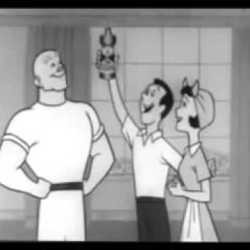
But there was one that always remained far and away my favorite.  Mr. Clean:

There’s nothing you can’t do, Mr. Clean!

Oh gosh, do I remember clapping along to this jingle!  I would get my Mom and Pia, my stocky middle-aged and eastern-European (Hungarian?) nanny, to join me in song and dance.  I was a very infectious musical conductor.

My Mom loved Mr. Clean because it made the floors so antiseptic you could eat off them (wait for it to dry first, please).  My Dad loved Mr. Clean, well, because my Mom loved Mr. Clean.  And me?  I was ecstatic to be the third wheel spinning in the love-a-thon.

THE END OF THE LINE

Arnold Eagle (1909-1992), Under the Third Avenue El, North of 27th St., New York, 1939, (480.1987)

Today, it’s just about impossible to find any trace whatsoever of the Third Avenue El.  The whole structure has been removed in its entirety.  The former support columns, formerly grounded in the roadway itself, have been paved over many times over.  The neighborhood surrounding Third Avenue and 55th Street, where PJ Clarke’s still exists today, is not recognizable from the 1940s-era photographs.

Union leader (and former Communist Party member) Michael J. Quill led a losing struggle to save the El, first in public hearings, then finally by picketing.  “In the last war there was an extensive mass transportation system to handle those who needed to use such facility because of the necessary curtailment of private transportation because of fuel shortages.  Will we have such facilities next time?” he argued in vain.  Postponed a few times, the last train ran on May 12, 1955, and the dismantling of the overhead trestles began in earnest.

“3rd AVE. EL”

(This post is also known as “THE LOST LINE, PART 2.” Next week, Part 3!)

The Third Avenue El in New York City was dismantled in 1955, so… it’s gone.  Forever.  It only today exists in our memories, collective consciousness, photographs, moving pictures, and really strange blogs (know any?).

Cosmologists explain that, from a multi-dimensional point of view, time can exist as a distinct physical address.  So, if you were to be a sentient being that exists in, say, 5, 6, or more dimensions, you could easily wander to the following spatial coordinates as if you walked from one house to another:

  1. Longitude: Third Avenue,
  2. Latitude: 53rd Street,
  3. Altitude: street-level, and
  4. Time (CE): 12 Noon, August 22, 1943 (the date of Bernard Olcott’s mother passing).

Just go to that location right now and look up!  You’ll be looking at the 53rd Street Elevated Station!

Given such liberty, it would be possible go anywhere in time, forwards and backwards, as if these were all reachable places.  Logically, all times past and future exist NOW; it’s just that they are inaccessible to us mortals.¹

The Bernard Olcott Story blog, unfortunately, cannot literally take the dear reader to the past (or future).  But what it can do is to present a brilliant short art house film that brings the Third Avenue El back to life, in sight and sound (complete with a harpsichord accompaniment).  It’s about eleven minutes long and follows four passengers as they journey uptown and downtown.  Click the Read More link right here to see the film:

THE LOST WEEKEND

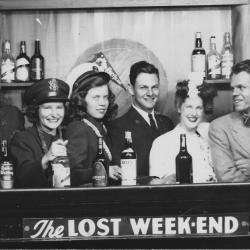
The Bernard Olcott Story starts off 2016 with a rewrite of my post “THE LOST WEEKEND” (the original of which I have just removed from this site).  When I wrote “THE LOST WEEKEND” last June, I reminisced about a picture of my Dad hamming it up with several friends in a photo booth heavy laden with cultural significance – see above picture.  All of which was lost to me since I did not grow up in the 1940s.  I shrugged off that photo booth picture, effectively asking if anyone recognized anything about it.  Nobody did.

That photo, it turns out, is a window into the New York City of yesteryear. This essay, and the next three will use the above image as a departure point into a black and white world.  I’ll take you back to New York City of the 1940s, my Father’s formative years as a newly minted Cooper Union graduate, and you’ll:

  • Read about the biggest movie of 1945,
  • Ride the El,
  • Hear old style New Yorkers interact,
  • Learn a valuable lesson at Cooper Union (a venerable institution dating back to the Lincoln Administration),
  • Review a mysterious death in 1943 with what little facts are available, and
  • Come back to a colorfilled present with a shared activity across time.

Why should you care?  Well, somehow you found this blog.  Perhaps in riding the El with my Dad, you may see some of yours in him.  Maybe you like nostalgic stories about Gotham City which was, in some ways, a completely different city from today’s Big Apple.

It could be that you are intrigued with the backstory of the founding of a business or how the tremendous loss of a parent could leave so little trace behind.  I still haven’t been able to figure out what happened to my paternal Grandmother, who passed away during this era.

Welcome back!

10,000 VIEWS!

This past week, just before I posted “GLORIA RATES MY T & A,” a quiet threshold was reached on The Bernard Olcott Story blog.  Since putting the page up late Saturday afternoon, February 14, 2015, from my ski loft at Hunter Mountain, New York – someone made the 10,000th view or click onto the site.

To the unknown clicker and to the entire readership, I say, a big THANK YOU is in order!

GLORIA RATES MY T & A!

Above photo by Bernard Olcott

As explained in my post SURPRISE!!!, gosh was I ever!  A new step-mom.  I didn’t really get too anxious about meeting my new step-mom because I didn’t have time – it was to be in 3 days!  Her clothes were in the closet.  She had already traveled with Dad to Brazil and Japan.  Silk wedding gowns adorned the walls.

So Gloria joined our small Olcott nuclear family.  This meant that whenever we went out for a road trip, which was often – and something I continue to do to this day between Québec and North Carolina – I had the pleasure of her company in the car.  Gloria was an excellent conversationalist.  And we tested each other right away.

THE HEIGHTS OF THE HELIPORT

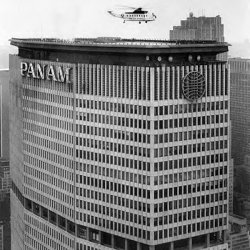
Today, we’ll set the way-back machine to 1965 when I was 7 years old.  My Dad had recently moved into the brand new Pan Am building (today the MetLife Building), his first year sharing space with the Taylor, Scholl, Ferencz, & Simon Law Firm in Suite 3219.  He would move to his own suite the following year.

I have written previously how I marveled at the modernity of the Pan Am building – to me, it was a vision of the future, please see my post DAD’S REAL WIFE.

Feast your peepers on the opening picture above.  Today’s story is about helicopters.

One of the most notable aspects of this building was the roof, which was completely flat except for a small enclosure housing the staircase down to the access gate and lounge.  As Pan Am was the owner, they had an innovative use for that real estate – a working heliport to ferry first-class passengers from midtown to JFK Airport!  Is that completely cool or what?  More lubricating than the switch downstairs from the Lexington IRT Express to the Local, right?

WORKING BIRDS AND THE MASTER FISHERMAN

For your Thanksgiving feast today, let me regale you with a story about working birds, not the ones you eat, but the ones that bring you food.  My Dad liked it when people were working.  This apparently applied to birds, too.

He often described to me his visits to Japan and the marvels that he was privileged to witness there.  Obviously, these trips reached him on some deep level.  Looking back, I can piece together several of these sojourns to the land of the rising sun, based on memory and souvenirs.  In my post last week HE WAS RICHLY STUNNED, I recounted how the currency exchange clerk followed him back to his hotel to refund him 50¢ in overcharges.  Dad was not the only one who was touched by his experiences in Japan – Gloria was too, and I will circle back to her at the end of this post.

The Japanese have a custom where they give each other small presents or keepsakes on the occasion of significant meet-ups.  It denotes respect and dignity for the relationship in a culture that is not outwardly expressive of such emotions.  Once, for example, while I was working at Mitsubishi International, my boss’ boss took a personal vacation to Mexico.  On his return, he presented every member of the entire department staff – including me – with a small bottle of Mexican hot sauce.  In fact, the verb in the Japanese language “to give” is hardwired to imply that one gives upwards to the receiver (ie., the giver is small).  Likewise, when you receive a gift, it is understood that you are receiving down (ie., the opposite, the receiver is small).  Harmony and grace are the operative assumptions of a culture where the population is crowded together in large cities and personal space is minimal.