WHEN A CHORE IS NOT A CHORE PART 1

After a few months at 974 Boulevard East in 1970, Dad found a new location for both his residence and the offices of Olcott International.  It was in a triple decker, similar to the millions that form the housing stock of Boston and environs.  But unlike the wooden ones in Massachusetts, this was constructed out of gold brick.  According to Dad, there were three layers of outer walls.  No wolf was ever gonna blow that house down!

It was on Weehawken’s eponymous Hamilton Avenue, the road atop the cliffs.  Across the street from the house, the cracked sidewalk and the rusting iron wrought fence gave way to an expansive view of the Hudson River and the west side of Manhattan.

Dad rented the first floor for the office and staked out the top floor, the third, as the residence.  The landlord lived in the apartment on the second, sandwiched, as it were, by Olcott rentals.

For years, Dad had rented bachelor style accommodations in New York and then in New Jersey when he moved to 974 Boulevard East.  No more.  The third floor was like the Taj Mahal in terms of spaciousness compared to the cramped quarters of times past.  There were multiple bedrooms, a central hall as well as separate living and dining rooms.  As this was the top floor, the ceiling everywhere was gabled into sharp points.

And yes, there was a kitchen!  A real one!

MY DAD’S BUDDHIST WEDDING!!

In 1983, Rosemary Egan was a nimble 32 year old brunette who worked the rigging (or the galley) as a crewmember of a 282 foot Windjammer sailing vessel that plied the aqua waters of the Bahamian outer banks.  This was not just any sailing vessel, but a real barkantine, a three-masted ship, square-rigged on the foremast and fore-and-aft-rigged on the other masts.  Up to 30 guests paid for the privilege of waking up in cabins to the sound of sea birds, feasting on lobster, hammocking in the rigging, cannonballing into the ocean and participating in the sailing.

When not hoisting a jib, Rosemary could be found singing and dancing in off-off-Broadway productions.  Show tunes were a specialty of hers.  And if not sailing, singing, or dancing, she had a steady part-time gig as a Medical Assistant.  It’s good to have multiple options.

You could say that she fit a certain profile.

One day after completing a cruise, she was waiting in line to check her luggage at Nassau International Airport for a return flight to Newark, New Jersey.  Born in New York City, she had moved with her folks to Plainview, New Jersey as a youngster during the exodus out of the city proper in the 1960s and 1970s.  Please see my posts “THE END OF AN ERA” and “WELCOME TO NEW JERSEY.”

As she struggled to move her luggage towards the check-in, a handsome stranger who resembled Jack Lord of Hawaii 5-O stepped in to help.  He was awfully chatty and his eyes lit up when he learned that she was part of the crew for Windjammer cruises.  He lifted her bag onto the check-in scale with utmost care and she watched her bag carted away into oblivion as it was promptly lost by the airline for days.  It was an omen of things to come.

IN DEMAND, AND THEN NOT

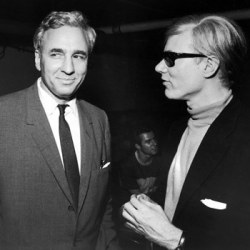
Huntington Hartford and Andy Warhol.  Photo courtesy of Vanity Fair.

A couple of weeks ago, one Sunday evening, I was driving back to my home in New York City from Hunter Mountain in upstate New York.  Most of my drive home was spent on the New York State Thruway, the major vehicular artery connecting the city to the state capital, Albany, and then on to Montréal via a continuation called the Northway.

As I approached the New Jersey border (please see my post WHAT’S IN A BORDER) driving southbound, I passed by Schunemunk Mountain on my right and then a succession of some small hills and valleys.  I also drove under a pedestrian overpass where I used to play a silly game with my children; the object of the game was to cross directly over the path of an oncoming car and get ‘run over’ (except, of course, you are on the overpass above).  Small children love this game – the direct opposite of “don’t play in traffic” – as well as parents with the mind of a small child.

Before crossing the border, I passed through a small dreary rural town called Hillburn.  After crossing, the sprawl of suburbanization was immediately palpable.

The last 20 miles took me through the northwest corner of New Jersey.  One of my favorite stops is a well-stocked A&P Supermarket in Allendale.  Not only does it feature a great selection of grocery items at low prices, but also has an unexpectedly good selection of wines.  Like 10 year old Pauillacs, perfect for drinking, which cannot be found in Manhattan (at least not 10 year old ones – damn wine bitches teefed all the good stuff).

To my surprise, I pulled up to see that the familiar A&P moniker that used to grace the façade above the front doors had been replaced by the new name ACME.  A&P, a retail business since 1859, alas, was now defunct.

It reminded me of a strange business investment solicitation my Dad received in the early 1980s.  In this case, I was not the wingman, but the paddleman.  Let me explain.

SURPRISE!!!

It was early summer 1971.  School was out.  Time for my annual flight from Orlando to New York, uh, I mean New Jersey.  I rode the plane up North like a nice person (as usual).  Disembarked at the brand new terminal at Newark Airport.  Ran into my Dad’s arms.  We got into the car.  Everything normal.

“How was your flight?” Dad asked as he tried to merge into the right lane, some angry driver honking furiously.  I looked to my right to see a cobra-faced man spewing venom in the car next to me.  Reflexively, I turned my gaze away, out the front.  A flock of New Jersey state birds let loose and took to the skies.

“Great,” I lied.  Seventh grade had been a tough year at Trinity Prep School, my new school that year.  What exactly had been “great” was that it was summer vacation and it was over.  On the last day of class, everybody had tossed their books to Hoe Brown, the class beast, who manually tore up each one into several strips of paper.

“How are things with you?” I asked.

Dad grinned.

He ignored my question and said, “I have something to tell you.” He looked at me for a moment.  We had survived the merge okay and were headed northbound on the New Jersey Turnpike, toward the glistening swamps and after that Weehawken.

HIS NAME WAS ALEXANDER HAMILTON

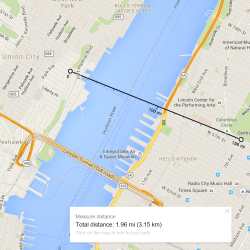
In 1970 Dad was happy with his relocation to Weehawken for tax and rent reasons.  As can be seen from the map above, his new home was less than 2 miles from the New York Athletic Club.

However, there was just one teensy little problem.  He literally could not get there from here.  Two miles away, true, is considered generally to be very close.  Assuming you can find your car keys, you can cover that distance in less than 5 minutes in most places in America.  Except from Weehawken to New York City during dining, drinking, and playing hours.

Dad tried, of course, to pop over to his old stomping grounds in Manhattan as usual.  And fatigued of it fairly quickly.  The traffic and parking turned out to be too much of a nightmare.  Thus, I imagine that Dad felt a little cut-off.  I am sure that he tried the Irish pub downstairs when he felt like “catting around” but found the local talent to be lacking.  He never went there with me or mentioned it to me, ever.

GOODBYE 212, HELLO 201?

Dad turned right to head from Park Avenue (Weehawken) over to Boulevard East where he turned left.  Directly ahead was the Manhattan skyline, in full view from the Battery all the way past Morningside Heights.  The North Tower of the World Trade Center could be seen rising to the right.  “Look at that view!” he declared again.  It was magnificent.  The centerpiece was the Empire State Building stretching regally skywards.  Ordinary and old-looking row houses lined the other side of avenue.

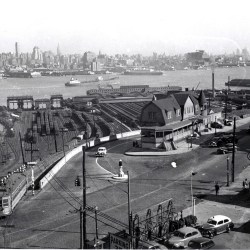
We pulled up to 974 Boulevard East, with its Dutch Colonial roof, which is found in the center of the 1930s era picture above.  It was one of the very few buildings to be found on the east side of the Boulevard, which was usually only a sidewalk, the railing, the Palisade cliffs tumbling down to the river, and of course, the view.  From Boulevard East onwards to the west was a hodgepodge of gerrymandered towns, sort of like the ones on the north side of the Charles River from Boston.  With names like Guttenberg, West New York, and North Bergen, these communities had all of the grit of Cambridge but none of the charm (although today there is a lot of new construction).  By 1970, the trolley line, the railroad pier, and depot down the cliff were all gone, the pier destroyed in a fire perhaps 20 years earlier.  It was a dreary and derelict waterfront.  The rotten posts formed a large swath of dots in the inky water off the trashed riverfront below, missing here and there like bad teeth.

974 Boulevard East itself had three creaky levels.  There was an Irish pub restaurant on the first floor.  The second floor hosted the offices of Olcott International & Company, newly incorporated and busy paying patents renewals in 60 countries around the world.  And a small air-conditioned cocoon of a studio apartment at the penthouse, the third floor.  I called it the “Little Retreat.”  “Look at this commute,” Dad said as he demonstrated walking up and down the small staircase between the second and third floors.  We both looked out the window at the river, the skyline, and boats plying the Hudson.  It was a mesmerizing tableau.  Was it truly goodbye area code 212, and hello 201?

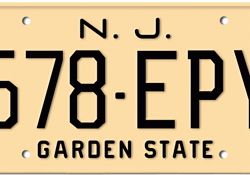
WELCOME TO NEW JERSEY!

It was mid June 1970.  I had just graduated from 6th Grade and had said good-bye to all my friends at Trinity Lutheran School in Orlando (who I never saw again spare one).  It was time to fly up to New York to be with Dad for the summer.

Mom drove me to McCoy Airport in Orlando for my flight up.  When we pulled up to the curb for Eastern Airlines departures, we looked at each other.  “Mom, do you have my ticket?”  She shouted something to the effect that she thought I had it.  We had 30 minutes until the flight left.  It was a 20 minute drive one way to get home.  “Put your seat belt on,” she said to me.  And then she hit the gas, real hard.

Traffic was moving serenely on I-4 that afternoon.  Except for one crazy lady in the brown Mercedes with the “lead foot.”  She drove hard on the left lane, up to the bumper of the car ahead.  She honked and shouted, “move it asshole!”  If asshole moved, she would race up ahead to the next asshole.  If asshole did not move, she would glance over her right shoulder, signal, and then the brown Benz would lurch over to the middle lane and race around asshole.

Not many people drove like that around Orlando.  Mom was the only one who ever honked.  I watched her masterfully maneuver the Benz like General Norman Schwarzkopf in the first Persian Gulf War; over, around, under any obstacle.  We reached our house, I raced inside, grabbed the ticket, and then back again to the car.  She roared down I-4 to chase more assholes down to McCoy.  I made the flight just in time.  I looked at my Mom with pride.  Homegirl could really bring it when needed.