HANGING PORK

(WARNING: THIS POST CONTAINS CONTENT BORROWED FROM GOP DEBATES.  PLEASE DO NOT READ IF YOU ARE OFFENDED BY GOP DEBATE CONTENT!)

Back home in America, the highway traffic stop is probably the greatest display of power a state like New York, New Jersey, Hawai’i (or any of the 47 others and 1 district) can exert over an unfortunate traveler.  There is an additional risk of nastiness if you happen to be driving while intoxicated, black, or as an American in the backroads of the USSR.  I fell solidly in the last two categories.

Back home, the cop car that pulls you over on I-95 (or H-1) is typically a blazing high performance Ford Crown Victoria festooned with the great seal of the state under whose laws, you, the hapless driver have apparently transgressed.  You get the whole show, complete with stylized hat, jack boots, ribboned trousers, shoulder brushes, leather pistol holster, handcuffs, the works.  Every state has its own variant of this uniform.  Be a very wary bear.

Dancing Bears cropped

Russian bears do dance, but these ain’t Russian!

Wrapped in the aforementioned trappings of authority, US States perform traffic stops with overdone celebratory unctuousness.  But everyone considers Connecticut or Alaska or the District to be relatively toothless.  We know, for example, that Connecticut is not going to build a wall around itself or deport everyone of Rhode Island descent. Not that there aren’t criminals from Providence stealing algae from the Connecticut River.  But I digress.  The states flash a lot of power by way of shiny patrol cars and uniform embellishments (big bark), but rank low on the holocaust scale (little dick).

IN SEARCH OF… MY FATHER’S MOTHER!

Before I cover the apparently sudden demise of my father’s mother Patricia in Queens, NY, on August 22, 1943, let me backtrack a bit and take a look at her origins.  At least the little that is known.  So I go in search of…  my paternal grandparents!

For that, my story today starts off on one beautiful bright Saturday morning in May 1985.  I was in a rental car rolling through verdant countryside.  The birds were chirping, the sun was streaming, and my Al Green cassette tape was cranking through the sound system; Al crooning “Love and Happiness.”  It was a happenin’ morning!

Yet this was not your normal stretch of New Jersey Turnpike, say between Elizabeth and Rahway.  Nor was I in a 1984 Buick LeSabre.  This road trip was distinctive for many reasons!

Well for one thing, the player’s fast forward was broken so when I got to the end of the last song on side 1, I had to eject the tape, stick my finger into one sprocket, and twirl the tape around my finger until I got to the end of side 1 (which was the beginning of side 2).

But that was just a nit.  Maybe it had something to do with the fact that I was rockin’ a recent vintage Volga sedan like the one pictured below.

MHV_ZiL_117_01

Switch out I-95, and sub-in the fact that I was rolling southbound on the A4, a rural two lane highway in Soviet occupied Lithuania.

MING AND DARTH

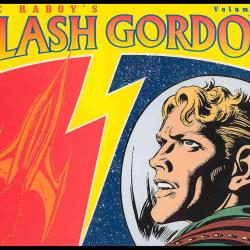
Aside from World War II and the War of the Worlds broadcast, there were other haps in the 1930s and 1940s that informed my Dad’s interests and personality.  For example, as he told me numerous times, his favorite comic strip of the era was Flash Gordon.  Flash was big at the time.  Dad loved Flash so much, it was even his college nickname!

As I reviewed the original comic strip in preparation for this post, I was struck by how much it resembles Star Wars of my generation.  The action takes place on the planet Mongo, locale of kingdoms like Arboria (forests) and Frigia (ice).  Kings and Queens galore!  And the villain?  A bad guy with interesting headwear!

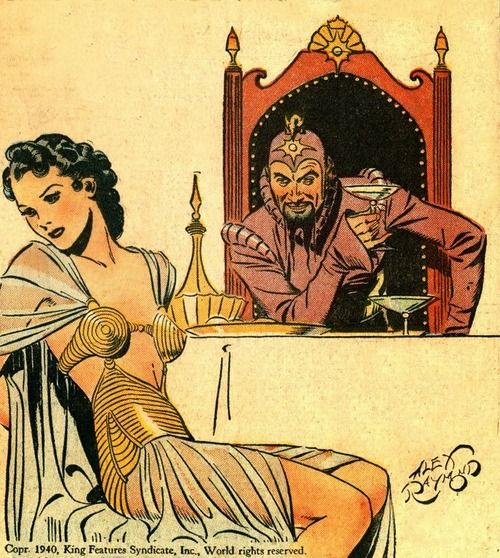
Ming the Merciless

Meet Ming the Merciless!

When looking at the above image of Ming, I am not sure if Darth Vader was ever so similar a lady killer.  Well, the young Jedi Anakin certainly was, in the prequels.  Unfortunately, he lost his man parts — GOP Presidential candidates please take note — on the lava planet (or moon, whichever) after losing the sword fight to Obi Wan.

On the other hand, what Flash didn’t have was the tiresome drama of Luke and Leia playing “who’s your daddy?”  Who needs parents anyway?  That’s right, you heard it asked here on the Bernard Olcott Story blog!

LEADING TO WAR

Over the past few weeks, I have written a lot about the 1940s, an era well before my time.  It was, by any measure, a very scary decade.

In my travels across Europe, I have gone looking for the remnants of World War II.  (Interestingly, none are visible in Japan, except for the gradual realization that all architecture is post 1950.)  There is the tour of Churchill’s bunker on King Charles Street in London.  Walking around Paris, you can’t help but notice the historical markers here and there memorializing the location where a patriot was shot by the Nazis.  In both cities, I have walked down certain streets and noticed numerous pockmarks on the graceful facades.¹

At times, I have looked up into the sky and tried to imagine the sounds of bombers, the rumble of artillery, or the rat-a-tat-tat of machine gun fire.  From the damage to the buildings around me, I could tell I was standing in the very places where hell reigned.  But, in every case, I failed to feel it.  Just cloudy skies above, and the sounds of traffic around me.  I could sense the highs and graces of Europe, but I just couldn’t visualize or feel the war that was very real.

The drumbeat to the war is best documented, in my opinion, in William L. Shirer’s remarkable tome The Rise and Fall of The Third Reich.  A bigoted politician – whose ancestor had fortuitously changed the family name from something sounding silly ² – built a national campaign scapegoating minorities to win an election in a major European state.  He successfully manipulated the new media of the era – radio and motion pictures – to win the adulation of the masses.³

https://youtu.be/GHs2coAzLJ8

Sound familiar?  Can’t happen here, right?

IN DEMAND, AND THEN NOT

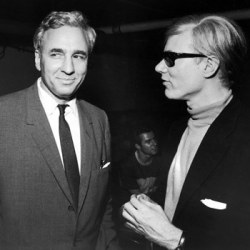
Huntington Hartford and Andy Warhol.  Photo courtesy of Vanity Fair.

A couple of weeks ago, one Sunday evening, I was driving back to my home in New York City from Hunter Mountain in upstate New York.  Most of my drive home was spent on the New York State Thruway, the major vehicular artery connecting the city to the state capital, Albany, and then on to Montréal via a continuation called the Northway.

As I approached the New Jersey border (please see my post WHAT’S IN A BORDER) driving southbound, I passed by Schunemunk Mountain on my right and then a succession of some small hills and valleys.  I also drove under a pedestrian overpass where I used to play a silly game with my children; the object of the game was to cross directly over the path of an oncoming car and get ‘run over’ (except, of course, you are on the overpass above).  Small children love this game – the direct opposite of “don’t play in traffic” – as well as parents with the mind of a small child.

Before crossing the border, I passed through a small dreary rural town called Hillburn.  After crossing, the sprawl of suburbanization was immediately palpable.

The last 20 miles took me through the northwest corner of New Jersey.  One of my favorite stops is a well-stocked A&P Supermarket in Allendale.  Not only does it feature a great selection of grocery items at low prices, but also has an unexpectedly good selection of wines.  Like 10 year old Pauillacs, perfect for drinking, which cannot be found in Manhattan (at least not 10 year old ones – damn wine bitches teefed all the good stuff).

To my surprise, I pulled up to see that the familiar A&P moniker that used to grace the façade above the front doors had been replaced by the new name ACME.  A&P, a retail business since 1859, alas, was now defunct.

It reminded me of a strange business investment solicitation my Dad received in the early 1980s.  In this case, I was not the wingman, but the paddleman.  Let me explain.

THE PROVENANCE OF DILIGENCE

The scenes featuring Gloria in “The Lost Weekend” are said to be shot in PJ Clarke’s bar, still at the corner of Third and 55th, but no longer under the shadow of the El.

It was not “New York’s New Yorkiest” joint, however, as declared by Walter Winchell, the leading radio personality of the 1940s and 1950s. That honor fell squarely on The Stork Club.

Unlike PJ Clarke’s unfortunately, nothing is left today of The Stork. Owner Sherman Billingsley was arguably one of New York’s greatest celebrities from the 1940s and 1950s. Where he once fought union pickets and sabotage, while throwing customers out (who dared to patronize the rival Harwyn club), a peaceful pocket park marks the former location of the famous glitzy eatery and bar.

There aren’t that many relics of old New York left. Probably one of the best “New Yorkiest” venues still in existence is the storied Cooper Union for the Advancement of Science and Art. It’s a puzzling institution in that many New Yorkers don’t seem to know about it. When I asked my Dad where he went to college, he told me proudly “Cooper Union” and when he noticed my quizzical look, proceeded to tell me about it.

LOOKING BACK AT THE FILM NOIR 1940s

“The Lost Weekend,” as previously noted in my post of the same name, was the Academy Award best picture of 1945.  It not only reveals Gotham of yesterday by way of moving images, like the main actor stumbling haggardly under the Third Avenue El in search of a drink, but also by way of the language and the accents of the era.  Unlike the 1960 classic “Butterfield 8,” the personalities in “The Lost Weekend” engage with each other directly, with a minimum of game playing or social charades.  It was the 1940s way.

Significantly, as it relates to The Bernard Olcott Story, it’s about a writer!  There’s even a reference to my distant cousin James Thurber (on my mother’s side) in the first few minutes.

What can you say about the film noir world of the 1940s, the formative decade for my Dad?  Well, for one thing, there were a HELL of a lot of barber shops.  Everywhere!

However, the first thing I noticed were the strong New York accents, most notably as spoken by the bartender Nat.  He routinely addresses the main character, Don Birnham, as “Mr. Boy-nam.”  This brings me back to working at Olcott International in Weehawken in the late 1970s and afterwards, please see my post “GOODBYE 212, HELLO 201?”

MR. CLEAN AND ANOTHER END

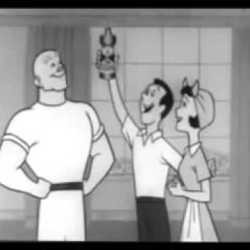
Back in 1961 and 1962, I would often be plopped down in front of the black and white television.  In between ‘Heckle and Jeckle’ and ‘Mighty Mouse‘ cartoons, there were commercials, many in great sing-along formats — sometimes both cartoons and commercials featured bouncing balls.

Heckle_and_jeckle_promo_picture[1]

But there was one that always remained far and away my favorite.  Mr. Clean:

There’s nothing you can’t do, Mr. Clean!

Oh gosh, do I remember clapping along to this jingle!  I would get my Mom and Pia, my stocky middle-aged and eastern-European (Hungarian?) nanny, to join me in song and dance.  I was a very infectious musical conductor.

My Mom loved Mr. Clean because it made the floors so antiseptic you could eat off them (wait for it to dry first, please).  My Dad loved Mr. Clean, well, because my Mom loved Mr. Clean.  And me?  I was ecstatic to be the third wheel spinning in the love-a-thon.

THE END OF THE LINE

Arnold Eagle (1909-1992), Under the Third Avenue El, North of 27th St., New York, 1939, (480.1987)

Today, it’s just about impossible to find any trace whatsoever of the Third Avenue El.  The whole structure has been removed in its entirety.  The former support columns, formerly grounded in the roadway itself, have been paved over many times over.  The neighborhood surrounding Third Avenue and 55th Street, where PJ Clarke’s still exists today, is not recognizable from the 1940s-era photographs.

Union leader (and former Communist Party member) Michael J. Quill led a losing struggle to save the El, first in public hearings, then finally by picketing.  “In the last war there was an extensive mass transportation system to handle those who needed to use such facility because of the necessary curtailment of private transportation because of fuel shortages.  Will we have such facilities next time?” he argued in vain.  Postponed a few times, the last train ran on May 12, 1955, and the dismantling of the overhead trestles began in earnest.

“3rd AVE. EL”

(This post is also known as “THE LOST LINE, PART 2.” Next week, Part 3!)

The Third Avenue El in New York City was dismantled in 1955, so… it’s gone.  Forever.  It only today exists in our memories, collective consciousness, photographs, moving pictures, and really strange blogs (know any?).

Cosmologists explain that, from a multi-dimensional point of view, time can exist as a distinct physical address.  So, if you were to be a sentient being that exists in, say, 5, 6, or more dimensions, you could easily wander to the following spatial coordinates as if you walked from one house to another:

  1. Longitude: Third Avenue,
  2. Latitude: 53rd Street,
  3. Altitude: street-level, and
  4. Time (CE): 12 Noon, August 22, 1943 (the date of Bernard Olcott’s mother passing).

Just go to that location right now and look up!  You’ll be looking at the 53rd Street Elevated Station!

Given such liberty, it would be possible go anywhere in time, forwards and backwards, as if these were all reachable places.  Logically, all times past and future exist NOW; it’s just that they are inaccessible to us mortals.¹

The Bernard Olcott Story blog, unfortunately, cannot literally take the dear reader to the past (or future).  But what it can do is to present a brilliant short art house film that brings the Third Avenue El back to life, in sight and sound (complete with a harpsichord accompaniment).  It’s about eleven minutes long and follows four passengers as they journey uptown and downtown.  Click the Read More link right here to see the film: