CRASHES NEXT TO ROOM 31, REVISITED

23 years after the events of my last story, “CRASHES NEXT TO ROOM 31,” would you know that your humble narrator is still plying the highways of the Garden State? In fact, I drive through the Lincoln Tunnel regularly on my way to work.

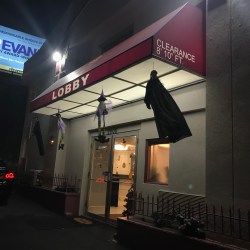
As I pondered this story, I was furtively glancing over my shoulder while exiting or entering the I-495 trench leading to the gaping hole of the Lincoln Tunnel. It’s a very busy place, a “great attractor” of traffic where cars merge and change lanes on a moment’s notice. I could only steal a glimpse or two safely of the former York Motel, more easily on the New York-bound side. It’s still there, looking much more polished in 2017 than it did in 1994 (or 1982). Gone is the sign advertising “hourly rates.” Up is the new logo of a national motel chain and what appears to be coat of fresh looking white paint.

I had never been a guest of the York Motel on a nightly – or otherwise – basis and thought that stopping by for a quick look around might be interesting. I wondered if I would be able to find the infamous room 31 and what the motel might look and feel like close up.

CRASHES NEXT TO ROOM 31

Crashes were not always relegated to software programs. Sometimes I experienced other kinds.  And they often happened close to the office.  Or next to scary places nearby.

In late spring 1994, Dad and I made a marketing call to a potential client without Bob. It was a major telecom company based in northern New Jersey, about an hour’s drive from Weehawken. The prospect was already running one of our competitor’s patent management systems, and wasn’t looking for a change. Rather, this was going to be a straight-up discussion about annuity payment services, right down Dad’s alley.

After some preparation, we plunked down inside my Dad’s lobotomized Mercedes Benz and traced our way to the company via the Garden State’s ribbon of expressways as guided by a crusty folded highway map.  As mentioned in my post “HIS NAME WAS BOB GERHARDT,” Dad had a method of increasing gasoline efficiency in automobile engines. It involved disabling multiple cylinders within the engine based on the simple premise that each cylinder is a source of fuel consumption and combustion. If you can shut them off, you will consume less fuel.

What could be simpler?

PAIR OF DEUCES, PART 3

Did I mention that 1994 was a busy year? Yes, I think I have, many times!

The trade shows that year were a hit! At the INTA trade show, I demoed our storied DOS program for trade marks and snagged a buyer. Too bad a minor bug in the program aborted the sale during the client install.

Soon after that botched installation, Dad and I were back in Washington in June for the AIPLA trade show. What INTA is for trade marks, AIPLA is for patents. That year, we had something that set us distinctly apart from the competition.

I mean, everyone had a DOS management system for patents. That’s where the fun began, of course. And then everyone had a fancy new Windows system as well. Windows had emerged as the ‘it’ system; everyone recognized it as the wave of the future. The version current at that time was Windows 3.1; Windows 95 was still a year away from introduction.

Only Olcott International had a third box, the cyclops eye of a computer system. An Apple Mac and a fully functional patent management system running on it.

PAIR OF DEUCES, PART 1

As technology rolled into the mid-1990s, the price of IBM-compatible machines dropped precipitously at just about the same time that big boxes graced with cow motifs began to litter the floors of Olcott International.

It was the advent of Gateway Computers!

gateway-computer-logo-md

While Yoshi still felt he could build ‘em cheaper from scratch, there was no arguing that buying from vendors like Gateway saved both time and money. In the end, Yoshi didn’t complain about giving up one of his many jobs; he had enough to do in terms of managing the patent payment system and troubleshooting hardware from whatever vendor.

Soon after I returned to Olcott International in June 1992, my work PC was updated from DOS to Windows 3.1. In my recent post “ASSEMBLY, PART 2,” I marveled at Yoshi’s ability to build clones from scratch and soon thereafter sought the secret knowledge so I could do it myself too.

We had a lot of computers lying around in the “Computer Department.” In addition to my new Widows 3.1 machine, Steve, Peggy, Bob, and of course Yoshi had their own PCs, running both DOS and Windows. I needed both Operating Systems (“OS”) as I was creating data and testing our two Patent Management Systems (“PMS”) resident in both environments.

However, there was one more desktop machine in the “Computer Department.” A shiny box with a glittering and different OS. One that made ethereal sounds when booting up with a picture of a smiling face. In fact, it was no clone at all; it was made by the same company that jealously guarded its fancy-schmancy operating system and had popularized the use of a mouse in a point-and-click type of interface.

The Apple Macintosh computer. I mentioned this cult-in-a-box in my post “CUTTING EDGE AND TOTALLY COOL.”

BASELINE

The memory I recounted in my post Assembly, Part 1, about my Dad putting together a pocket watch for me is not a particularly strong one. In fact, it’s like an alternative recall that really doesn’t come readily to mind. For one thing, there’s not that much action in it, and certainly nothing approaching anything like real drama. Just a quiet moment in a temporary home, years ago, in the distant past.

I didn’t ask for a gift that morning and I had no idea one was coming my way.  Like a faint shadow on old paint, it’s there to remind you if your eye happens to fall on it while you’re thinking about or doing something else.

For me, I have similar experiences sometimes while listening to music during long drives in my car. I hear the music, but I am focused on the road and other traffic. One of those melodies can suddenly appear front and center in my consciousness days later, and I am left with some chord structure or arrangement in endless mental repetition. The bad ones we call earworms, annoying feedback loops of muzak that would be better eaten by birds.

ASSEMBLY, PART 2

As I wrote last week, my Dad, like some of his contemporaries, resisted the advent of the PC age. It’s kind of a conundrum since he created a new industry on the back of new technology and thoroughly disrupted the patent renewal business thirty years hence. Once achieving ascendancy, however, he complacently resigned his role as innovator when he moved his booming company to New Jersey. But he still sought control over everything.

Sure enough, others, like Jerry Van Winter and Bob Gerhardt, arose to begin the next cycle of cannibalization in this niche marketplace. During the 1970s, the competitive pressures those gentlemen brought to bear on the market began to take its toll on Olcott International. This threatened Dad’s ability to maintain control.

When Bob Gerhardt became a free agent in the mid-1980s, Dad felt compelled to co-opt him. In “HIS NAME WAS BOB GERHARDT,” I wrote about how I lugged Bob’s Compaq laptop into the office one day in 1985.

ASSEMBLY, PART 1

In the summer of 1966, I lived with Dad as an 8 year old in his temporary home in Morrisville, Pennsylvania. Sort of like today where I am a transient resident of nearby Reading (except now, I am seriously older than 8!)  Forget about the famous railroad company from ‘Monopoly,’ the Reading Railroad was closed years ago.

For whatever reason, I just keep coming back to the Keystone State.

One morning that year, I woke up to find, not to my surprise, that Dad had already been awake for several hours. This wasn’t unusual for him. He had bought some kind of model kit the day before for a pocket watch made out of hard blue plastic. Early that morning, while I was snoozing away, he had painstakingly detached all the pieces from the molds.

Then, carefully and slowly, Dad followed the detailed instructions to assemble the watch. All parts were made in the aforementioned blue plastic: the sprockets, cogs, case, the hour and minute hands, everything save for the spring and the clear transparent plastic cover that snapped into place over the clock face.

A BRIEF INTRODUCTION

Please allow me to introduce you to Bernard Olcott, 1918-2006, a man who led a legendary and iconoclastic American life.

Welcome to my blog.  My goal is to provide you with stories from times past by which you might catch glimpses of yourself, or of someone you know intimately. Bernard Olcott touched the world, from Japan to England to Egypt to Kansas to New Jersey. Maybe you know some of these places, too.

Every Thursday afternoon from 2015 through 2018, I presented you with a new story, some new adventure or insight, dusted with more than just a little modern context and quirky cultural references. Dad loved screwball humor; although he took himself seriously as an attorney, he wouldn’t stop laughing if you called him an ‘ambulance chaser.’  You see, this is the point: we can’t pick our parents, but we sure as hell can cherry pick their best qualities. And that, my friends, is what will set you free.  Since 2018, the blog is pretty much finished and I am compiling the stories in chronological order.  What you see below are the original posts.

SOMETHING ABOUT DAD, PART 2: FREE PARKING

Part 2 of the “SOMETHING ABOUT DAD” series.  Continues from last week.

During Christmas break in 1979, a trip was planned to the family houseboat, which was permanently moored at the Hurricane Hole Marina, under the Paradise Island Bridge on Paradise Island in glistening Nassau, the Bahamas.  I had never been there before but had heard a lot about it from Gloria and Dad so I was looking forward to going.

A day or two before, Gloria went to the Shop Rite supermarket in less-than-glistening Union City, to shop for groceries to bring on the plane to the Bahamas.

“What?!  Bring groceries on the plane?  Are you sure we need to do this?” I asked.

She assured me that supermarkets in Nassau were both terrible and overpriced.  And this is what they had done on previous trips.  I suspected that this was my Dad’s idea but anyway she seemed to be completely on board.  I tried to imagine what a terrible supermarket looked like and immediately thought of Shop Rite.  Could it be any worse?  Besides, I was weirded out with the idea of lugging brown paper supermarket bags filled with chopped meat and such onto the plane.  This was just about the turning point when airplanes came to be thought of as buses with wings.  And board that flying bus we did, complete with our groceries from Shop Rite!

YES DEPOSIT, YES RETURN

While I am busy writing my next story “PAIR OF DEUCES,” I offer up my very first post, written 3 years ago.  In fact, you can find it if you scroll all the way to the bottom.  I’m not sure if many readers do, so here it is.  It’s an amusing story about my Dad and some business he needed to conduct at Shop Rite one day in the 1980s.  I never saw this coming.  Not in a million years.  Hope you enjoy it!

No matter the routine, things could get crazy.  Fast.

Lunch with Bernard Olcott at Olcott International in 1983 followed a familiar routine.  At around maybe 11:45 AM, after a few hunger pangs had already hit me pretty hard, I would head up to the top floor, the level that actually connected to the street, and ask if he was ready to grab some lunch.  He would typically wave me off for another 10 to 15 minutes while he finished up some correspondence.  Finally, he would call me back upstairs.   We would then spend another 10 to 15 minutes looking for a pack-of-cards sized contraption holding perhaps 50 keys for the car, the house, the office, the boat, and God knew what else.  Oddly they were never in the same place twice.  And if not retrieved, well, that would have been the end of the world, as we knew it.

The next part of the routine would be to drive over to the Shop Rite supermarket on JFK Boulevard in Union City, New Jersey.  This was located in a bustling area with a huge parking lot in front.  However, it was only sensibly approachable from the southbound lane.  This presented an engineering problem to Dad, the kind he loved to solve.