BOOMERANG IN THE AIR FROZEN


This blog ostensibly concerns my Father, Bernard, who passed away in 2006.  But I take many diversions along the way.  Today’s post is mostly about his 2nd wife, my Mom.  She is a spry 83 year old woman who brags about her ability to walk around the parking lot in front of her Assisted Living Residence “23 times” every day.  She is very specific about that number.

OK, so what do you do with your aging Mother when you bring her home for the weekend?  In my case, I take her for long walks.  Makes sense, right?

This past Sunday, I brought her and my cousin, Lise (visiting from Quebec City), for an excursion to the Four Freedoms Park on Roosevelt Island.  It’s a stunning modern memorial to, in my opinion, the greatest President of our Republic.  Our very own Great Leader, the handicapped patrician who led our country through its darkest hour to supreme victory and ascendancy to superpower status, militarily, economically, and culturally.  FDR.  Now we have a Washington, DC-style monument in his honor, right here in the middle of the East River.

IN SEARCH OF… MY FATHER’S MOTHER!

Before I cover the apparently sudden demise of my father’s mother Patricia in Queens, NY, on August 22, 1943, let me backtrack a bit and take a look at her origins.  At least the little that is known.  So I go in search of…  my paternal grandparents!

For that, my story today starts off on one beautiful bright Saturday morning in May 1985.  I was in a rental car rolling through verdant countryside.  The birds were chirping, the sun was streaming, and my Al Green cassette tape was cranking through the sound system; Al crooning “Love and Happiness.”  It was a happenin’ morning!

Yet this was not your normal stretch of New Jersey Turnpike, say between Elizabeth and Rahway.  Nor was I in a 1984 Buick LeSabre.  This road trip was distinctive for many reasons!

Well for one thing, the player’s fast forward was broken so when I got to the end of the last song on side 1, I had to eject the tape, stick my finger into one sprocket, and twirl the tape around my finger until I got to the end of side 1 (which was the beginning of side 2).

But that was just a nit.  Maybe it had something to do with the fact that I was rockin’ a recent vintage Volga sedan like the one pictured below.

MHV_ZiL_117_01

Switch out I-95, and sub-in the fact that I was rolling southbound on the A4, a rural two lane highway in Soviet occupied Lithuania.

IN DEMAND, AND THEN NOT

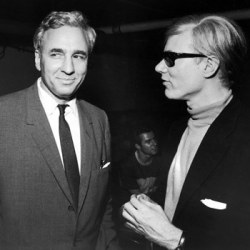
Huntington Hartford and Andy Warhol.  Photo courtesy of Vanity Fair.

A couple of weeks ago, one Sunday evening, I was driving back to my home in New York City from Hunter Mountain in upstate New York.  Most of my drive home was spent on the New York State Thruway, the major vehicular artery connecting the city to the state capital, Albany, and then on to Montréal via a continuation called the Northway.

As I approached the New Jersey border (please see my post WHAT’S IN A BORDER) driving southbound, I passed by Schunemunk Mountain on my right and then a succession of some small hills and valleys.  I also drove under a pedestrian overpass where I used to play a silly game with my children; the object of the game was to cross directly over the path of an oncoming car and get ‘run over’ (except, of course, you are on the overpass above).  Small children love this game – the direct opposite of “don’t play in traffic” – as well as parents with the mind of a small child.

Before crossing the border, I passed through a small dreary rural town called Hillburn.  After crossing, the sprawl of suburbanization was immediately palpable.

The last 20 miles took me through the northwest corner of New Jersey.  One of my favorite stops is a well-stocked A&P Supermarket in Allendale.  Not only does it feature a great selection of grocery items at low prices, but also has an unexpectedly good selection of wines.  Like 10 year old Pauillacs, perfect for drinking, which cannot be found in Manhattan (at least not 10 year old ones – damn wine bitches teefed all the good stuff).

To my surprise, I pulled up to see that the familiar A&P moniker that used to grace the façade above the front doors had been replaced by the new name ACME.  A&P, a retail business since 1859, alas, was now defunct.

It reminded me of a strange business investment solicitation my Dad received in the early 1980s.  In this case, I was not the wingman, but the paddleman.  Let me explain.

THE PROVENANCE OF DILIGENCE

The scenes featuring Gloria in “The Lost Weekend” are said to be shot in PJ Clarke’s bar, still at the corner of Third and 55th, but no longer under the shadow of the El.

It was not “New York’s New Yorkiest” joint, however, as declared by Walter Winchell, the leading radio personality of the 1940s and 1950s. That honor fell squarely on The Stork Club.

Unlike PJ Clarke’s unfortunately, nothing is left today of The Stork. Owner Sherman Billingsley was arguably one of New York’s greatest celebrities from the 1940s and 1950s. Where he once fought union pickets and sabotage, while throwing customers out (who dared to patronize the rival Harwyn club), a peaceful pocket park marks the former location of the famous glitzy eatery and bar.

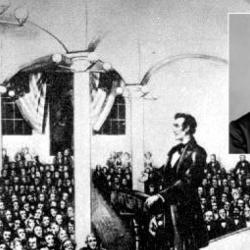
There aren’t that many relics of old New York left. Probably one of the best “New Yorkiest” venues still in existence is the storied Cooper Union for the Advancement of Science and Art. It’s a puzzling institution in that many New Yorkers don’t seem to know about it. When I asked my Dad where he went to college, he told me proudly “Cooper Union” and when he noticed my quizzical look, proceeded to tell me about it.

LOOKING BACK AT THE FILM NOIR 1940s

“The Lost Weekend,” as previously noted in my post of the same name, was the Academy Award best picture of 1945.  It not only reveals Gotham of yesterday by way of moving images, like the main actor stumbling haggardly under the Third Avenue El in search of a drink, but also by way of the language and the accents of the era.  Unlike the 1960 classic “Butterfield 8,” the personalities in “The Lost Weekend” engage with each other directly, with a minimum of game playing or social charades.  It was the 1940s way.

Significantly, as it relates to The Bernard Olcott Story, it’s about a writer!  There’s even a reference to my distant cousin James Thurber (on my mother’s side) in the first few minutes.

What can you say about the film noir world of the 1940s, the formative decade for my Dad?  Well, for one thing, there were a HELL of a lot of barber shops.  Everywhere!

However, the first thing I noticed were the strong New York accents, most notably as spoken by the bartender Nat.  He routinely addresses the main character, Don Birnham, as “Mr. Boy-nam.”  This brings me back to working at Olcott International in Weehawken in the late 1970s and afterwards, please see my post “GOODBYE 212, HELLO 201?”

WORKING BIRDS AND THE MASTER FISHERMAN

For your Thanksgiving feast today, let me regale you with a story about working birds, not the ones you eat, but the ones that bring you food.  My Dad liked it when people were working.  This apparently applied to birds, too.

He often described to me his visits to Japan and the marvels that he was privileged to witness there.  Obviously, these trips reached him on some deep level.  Looking back, I can piece together several of these sojourns to the land of the rising sun, based on memory and souvenirs.  In my post last week HE WAS RICHLY STUNNED, I recounted how the currency exchange clerk followed him back to his hotel to refund him 50¢ in overcharges.  Dad was not the only one who was touched by his experiences in Japan – Gloria was too, and I will circle back to her at the end of this post.

The Japanese have a custom where they give each other small presents or keepsakes on the occasion of significant meet-ups.  It denotes respect and dignity for the relationship in a culture that is not outwardly expressive of such emotions.  Once, for example, while I was working at Mitsubishi International, my boss’ boss took a personal vacation to Mexico.  On his return, he presented every member of the entire department staff – including me – with a small bottle of Mexican hot sauce.  In fact, the verb in the Japanese language “to give” is hardwired to imply that one gives upwards to the receiver (ie., the giver is small).  Likewise, when you receive a gift, it is understood that you are receiving down (ie., the opposite, the receiver is small).  Harmony and grace are the operative assumptions of a culture where the population is crowded together in large cities and personal space is minimal.

PAN AM TO LONDON IN 1969

I took my first business trip with Olcott International in 1969. Of course, it wasn’t really a business trip as I was only a kid, 11 years old. But it was for my Dad. I tagged along and was on the periphery of a proposed merger of his operation with the patent renewal portfolio of one of Europe’s (and the world’s) largest law firms.

The latter part of the 1960s found me in elementary schools in Orlando, Florida during the school year and then back in New York City with Dad during the summers. Nine months of fourth grade to a kid seems to last at least 500 years with 11 months tagged on. For grades K through 4, I attended Cathedral School near Lake Eola in downtown Orlando in a building that must have looked old during the Roosevelt administration. During the interminable period between September and June every year, I was bored witless. But Dad kept my attention, even when I was far away from him.

THE BIGGER IDEA (AND ME AS WINGBOY)

So Dad got the idea for a fantastic business related to patent filings and infringements, kind of an amalgam between legal and IT but not a legal practice, strictly speaking.   As I am able to remember it, he had become friendly with Ed Greer, who was head patent counsel for the Union Carbide Corporation. Union Carbide was one of the biggest chemical corporations of the day and was headquartered in their own magnificent skyscraper two blocks up Park Avenue from the Pan Am Building.

It was a probably a simple matter for Dad to put it together that large corporate patent owners could benefit from some form of computer calendaring.

Keep in mind that a large company like Union Carbide owned a large portfolio of patents. They would initially file patent applications in the home country, USA for Union Carbide. And as they were a large multinational corporation selling their wares everywhere, once the patent applications were accepted here at home, they would then engage in an international filing program elsewhere, typically the largest 15 countries in Western Europe and then Canada, Japan, Australia, New Zealand, and maybe Brazil and South Africa to boot.

SOMETHING ABOUT DAD, PART 1: THE ZINGER

Above from left, Dad, Addie, Uncle Ritchie, Me, and Gloria in the late 1970s.

1979 and 1980 were seminal years.  I was a senior in college and it was time to contemplate a career.  Of course, I had no idea what it was I wanted to do.  My roommate Dan, on the other hand, was feverishly interviewing at Goldman Sachs and other Wall Street firms.  He ultimately scored a great job and is now in charge of some place like Europe.  But for me, all I knew is that I wanted “something international” but was undecided between the public service arena (like the Foreign Service or the United Nations) or international business (I would land my dream internship at United Nations within 2 years to try it out).  My Dad had made many off-handed remarks to people over the years that I was to join him at Olcott International and “take it over.”  I think I was 6 the first time he said that to someone in my presence.  So I had grown up with this as a possible notion.  But now at 21 years of age, I was suddenly ambivalent.  There was something peculiar about Dad.

Over the last few years, things had changed between my Dad and his 4th wife Gloria.  When I first met Gloria in 1971, I was 13.  I was hardly mature but I could tell that they seemed to be happy together and the Olcott household was a cheerful one.  Gloria was funny, with it, traveled with Dad to Brazil and Japan, and even wrote me a poem for my 14th birthday, dedicated to me as the “stalwart lad.”  On top of that, they left me a stash of Playboys in my bedroom, though Gloria removed certain issues she felt were too racy.  It certainly seemed that just maybe Dad had turned a corner from 3 failed marriages and that the future was going to be more stable.  Hope had sprung eternal.  After all, Hope was Gloria’s middle name.